


Early Warning Signs a Regular Listing Is Turning Into a Short Sale

The listing started normally.
Nice photos. Reasonable seller. Maybe a little stress in the background, but nothing that screamed "distressed sale."
Then the showings slowed. The seller stopped returning documents quickly. The payoff looked a little suspicious. Suddenly, the agent is trying to figure out whether this is still a regular listing or whether it quietly became a short sale while everyone was busy discussing paint colors.
That is the moment to pay attention.
The goal is simple: spot short sale risk early enough that the file can still be organized, priced correctly, and moved toward a real closing instead of becoming a last-minute emergency.
Why Agents Miss the Warning Signs
Most listings do not announce themselves as short sales on day one.
Sometimes the seller is embarrassed. Sometimes they do not understand the payoff. Sometimes they think the market will solve the problem. Sometimes they are hoping for a miracle offer, which is not technically a pricing strategy, although it does make for lively group texts.
The issue is that short sale problems usually get worse with time.
If the listing is overpriced, market time increases. If payments are late, foreclosure pressure builds. If liens or HOA balances are ignored, closing gets harder. If the seller waits too long to disclose hardship, the agent loses valuable time.
That is why agents should treat early warning signs seriously. You are not trying to label every tight-equity listing as a short sale. You are trying to find out whether the deal needs short sale assistance before the calendar starts making decisions for everyone.
Warning Sign 1: The Payoff Does Not Match the Market
The first clue is usually math. If the mortgage payoff, second mortgage, liens, HOA balance, taxes, commissions, and closing costs exceed what the home can realistically sell for, the file may not be able to close as a normal sale.
The key word is realistically.
A seller may believe the house is worth more. A neighbor may have sold high two years ago. A buyer may appear eventually. But if current comps, condition, showing feedback, and market time all point lower, the agent should not ignore the gap.
A short sale starts becoming likely when the only way to close is for the lender or another lienholder to accept less than the full amount owed.
Warning Sign 2: The Seller Cannot Bring Money to Closing
A payoff shortage is one problem. The seller's ability to cover it is another.
Agents should ask direct, practical questions early:
- If the home sells at market value, can you bring money to closing?
- Are there any second loans, judgments, tax liens, or HOA balances?
- Have you checked the current payoff, not just the monthly statement?
- Are you current on the mortgage and association dues?
If the seller cannot bring funds to closing and the numbers do not work, the listing may need a short sale specialist before an offer is accepted, not after everyone is already frustrated.
For agents who want support while keeping the client relationship intact, Crisp's approach to helping real estate agents handle short sale files is built for exactly this situation.
Warning Sign 3: The Seller Is Behind, But Avoiding the Topic
Sellers do not always volunteer that they are behind.
They may say things like:
- "We are trying to catch up."
- "The bank is working with us."
- "There is no sale date yet."
- "We just need to sell quickly."
Those statements are not proof of a short sale, but they are strong signals that the agent should ask more questions.
If missed payments are already involved, time matters. The file may need lender review, hardship documentation, payoff statements, title review, buyer coordination, and foreclosure tracking. That is a lot to discover after a contract is signed.
This is where it helps to start the short sale process before deadlines tighten, especially if there is already an offer or serious buyer interest.
Warning Sign 4: The Seller Keeps Rejecting Market Feedback
Some sellers resist price reductions because they want to walk away with money. That is normal. But when the numbers are tight, resistance to market feedback may be a sign that the seller has not accepted the financial reality.
If the seller needs a certain price only because that is what would pay off the loan, that price may not be market value. It may simply be the seller's break-even number.
Agents should separate the two. A listing can be priced at the amount the seller wants, or it can be priced where the market is likely to respond. In a potential short sale, confusing those two numbers can burn the time needed to negotiate the file.
Warning Sign 5: There Are Liens, HOA Balances, or Title Problems
Sometimes the mortgage is not the only problem.
A regular listing can become a short sale because of second mortgages, judgments, IRS liens, unpaid property taxes, HOA dues, condo association balances, collection attorney fees, or other title issues that have to be paid or released before closing.
For example, an HOA payoff letter should usually be ordered after approval when the file is closer to closing, but an account balance statement should be gathered early so the total amount owed is accounted for in the deal.
If these items are discovered late, the settlement statement may no longer work. The lender may need to approve different numbers. The buyer may need an extension. Title may need releases. The file can turn from straightforward to complicated very quickly.
Crisp helps agents and sellers organize these moving parts through short sale processing support that keeps the file moving, including payoff issues, lien review, document collection, and lender communication.
What Agents Should Do First
When a regular listing starts showing short sale warning signs, the next step is not panic. It is verification.
Agents should move through a short, practical checklist:
- Confirm the current mortgage payoff.
- Review realistic market value, not wishful pricing.
- Ask whether the seller can bring money to closing.
- Identify hardship early.
- Check payment and foreclosure status.
- Look for second liens, HOA balances, judgments, taxes, or title issues.
- Adjust pricing before market time becomes a bigger problem.
- Get short sale help if the numbers no longer support a normal closing.
The earlier the issue is identified, the more options the seller and agent usually have. Waiting until a buyer is under contract can still work, but it often creates avoidable pressure.
The Bottom Line
A regular listing can turn into a short sale gradually.
It may start with a payoff gap, a seller who cannot bring money to closing, missed payments, lien issues, HOA balances, or pricing resistance that does not match the market.
Agents do not need to solve every short sale problem alone. But they do need to recognize when the file is no longer behaving like a normal sale.
The sooner those warning signs are caught, the easier it is to organize the file, protect the timeline, communicate honestly with the seller, and give the transaction a real chance to close.
Because the worst time to discover a short sale is when everyone thought they were already at the finish line.

Texas Foreclosure Sale Date Coming Up? When a Short Sale Can Still Work

The foreclosure sale date is on the calendar.
The seller is panicking. The agent is trying to figure out if the listing can still be saved. The buyer, if there is one, wants to know whether this deal is real or just a very stressful group project with worse snacks.
The goal is simple: stop the file from drifting into foreclosure and see whether a short sale can still create a better outcome.
In Texas, timing matters a lot. Foreclosure sales are commonly scheduled quickly, and once that date is approaching, every delay becomes more expensive. A short sale may still work, but only if the right pieces move fast and in the right order.
First, Confirm the Sale Date
Before anyone starts guessing, confirm the actual foreclosure sale date. Not "sometime soon." Not "I think next month." The actual date.
That date controls everything.
If there is enough time to submit a complete short sale package, the lender may review the file and consider postponing the foreclosure sale. If the file is incomplete, disorganized, or missing key documents, the lender has very little reason to stop the process.
This is where early short sale help before the foreclosure clock gets tighter can make a real difference. The goal is not just to submit something. The goal is to submit something the lender can actually review.
A Short Sale Is Not Just an Offer
One of the biggest mistakes agents and sellers make is thinking the offer itself is the short sale package.
It is not.
The offer matters, but the lender usually needs much more before it can evaluate the request. That may include the seller's hardship letter, financial worksheet, bank statements, pay stubs, tax documents, listing agreement, purchase contract, estimated settlement statement, authorization forms, and supporting property information.
If the lender asks for documents one at a time, the file can bleed days quickly. In a Texas foreclosure timeline, days are not decorative. They are the deal.
A strong short sale coordinator helps make sure the package is complete, current, and presented in a way the lender can process without bouncing it back for avoidable reasons.
The Lender Needs a Reason to Postpone
A lender does not usually postpone a foreclosure sale just because someone asks nicely.
It needs a file that shows there is a realistic alternative to foreclosure.
That means the short sale request should show:
- The seller has a legitimate hardship.
- The property value supports the offer.
- The buyer appears serious and qualified.
- The numbers make sense.
- The file is complete enough for review.
- The closing path is realistic.
If the lender sees a half-built file, it may keep the foreclosure moving. If it sees a complete file with a real offer and a clear path to closing, there may be a better chance of getting attention.
This is why how we help agents and homeowners organize short sale files is not just paperwork support. It is about giving the lender a usable file before the timeline collapses.
What If There Is No Offer Yet?
A short sale can be harder without an offer, but that does not always mean the situation is hopeless.
If the property is listed, priced realistically, and marketed properly, the agent may still be able to create activity. The important part is being honest about value. An inflated list price can waste the most important days the seller has left.
If the property has already been sitting with little activity, the agent should look at pricing, condition, access, buyer feedback, and comparable sales immediately. A lender is not likely to take a weak offer seriously if the pricing story is sloppy.
In a foreclosure-pressure situation, "let's test the market" can become very expensive. The market already gave feedback. Listen to it.
What If the Buyer Is Ready?
If there is already a buyer, the focus shifts to packaging and urgency.
The buyer's offer should be clean. Financing should be credible. Proof of funds or pre-approval should be included. The estimated settlement statement should reflect realistic costs. Any HOA balances, liens, taxes, or second mortgages should be identified early.
This is where a short sale specialist or short sale negotiator can help prevent the file from going sideways. The lender is not only reviewing price. It is reviewing whether the deal can actually close.
A good offer with bad paperwork can still lose to the calendar.
Agents Should Not Wait for One More Update
When a foreclosure sale date is close, waiting passively for updates is usually the wrong move.
The file needs active follow-up. Not random "just checking in" emails, but specific follow-up tied to what the lender needs next.
Has the file been opened?
Has the authorization been accepted?
Has the hardship package been marked complete?
Has a negotiator been assigned?
Has valuation been ordered?
Has the foreclosure department been notified that a short sale review is pending?
These details matter. They are the difference between "we submitted it" and "the lender is actually reviewing it."
For agents who want support without losing control of the client relationship, who we serve in short sale transactions explains how the right back-end team can support the file while the agent stays in position.
Can a Short Sale Stop Foreclosure in Texas?
Sometimes, yes. But it depends on timing, lender policy, investor rules, file quality, and how close the sale date is.
No one should promise a foreclosure postponement. That is a lender decision, and every file is different.
But a complete short sale request can give the lender something to evaluate before foreclosure happens. If the numbers make sense and the file is moving, the lender may decide that reviewing the short sale is better than pushing forward with foreclosure.
That is the window you are trying to create.
The Bottom Line
A Texas foreclosure sale date is serious, but it does not always mean the door is closed.
The key is speed plus structure.
Confirm the date. Build the file. Get the documents. Price realistically. Submit a complete package. Follow up with purpose. If there is a buyer, make sure the offer is clean and credible.
A short sale under foreclosure pressure is not the time for vague updates or "we'll see what happens."
It is the time to move the file like the calendar matters, because it does.

Short Sale vs Foreclosure Credit Impact in 2026

The missed payments are already stressful. Then the homeowner starts thinking about what comes next: credit damage, buying again someday, explaining the situation to a future lender, and whether foreclosure will follow them around like a bad financial tattoo.
That is usually when the short sale question gets serious.
For many distressed homeowners, the decision is not really “short sale or perfect credit.” That ship may have already left the dock wearing sunglasses. The real question is whether a short sale can create a cleaner exit than letting the property go all the way to foreclosure.
In many cases, yes. But the details matter.
The Credit Damage Usually Starts Before Either Option
By the time a homeowner is comparing a short sale vs foreclosure, the credit impact may already be underway. Missed mortgage payments are often the first major hit. Late payments can damage credit before the short sale is approved and before the foreclosure sale happens.
That is important because some homeowners assume the short sale itself is the only credit issue. Usually, it is not. The total impact can include:
- Missed mortgage payments
- Collection activity
- Foreclosure filings
- Charge-off or settlement reporting
- Deficiency balance issues
- Public record or court activity, depending on the state and process
A short sale does not erase the fact that payments were missed. But it may help stop the situation from turning into a completed foreclosure.
That distinction can matter when the homeowner is trying to recover.
Why Foreclosure Is Usually the Harsher Outcome
Foreclosure means the lender completed the legal process to take back or sell the property. From a future lender’s perspective, that can look more severe than a negotiated short sale because the borrower did not resolve the debt before the foreclosure process reached the finish line.
A short sale, by contrast, is a negotiated sale where the lender agrees to accept less than the full payoff to release its lien. The homeowner still sold the property, the lender reviewed the file, and the transaction closed through a formal approval process.
That does not make a short sale painless. But it may be viewed differently than foreclosure because the homeowner took action before the property was lost at sale.
This is why timing matters. If the foreclosure date is already close, the homeowner may still have options, but the path gets narrower. Starting early gives the lender more time to review the hardship, buyer offer, valuation, title issues, and closing terms.
If a homeowner is already behind, the better move is usually to start the short sale process before the foreclosure clock gets too loud.
Short Sale Reporting Can Vary
One reason this topic gets confusing is that short sales are not always reported the exact same way. Credit reporting can depend on the lender, loan type, account status, settlement terms, and how the servicer reports the account after closing.
A short sale may appear with language such as settled, paid for less than the full balance, account legally paid in full for less than owed, or similar wording. The exact phrasing matters less than the bigger point: it is generally different from a completed foreclosure.
Homeowners should not rely on casual promises like “this will not hurt your credit.” That is not how this works. A short sale can hurt credit. The question is whether it may be less damaging, more controlled, and more recoverable than foreclosure.
That is where experienced short sale help matters. The file should be reviewed for approval terms, deficiency language, lien releases, settlement statement accuracy, and closing conditions before anyone assumes the seller is protected.
The Deficiency Balance Can Matter Too
Credit impact is not the only issue. A homeowner also needs to understand whether the lender may pursue a deficiency balance after the sale.
A deficiency is the difference between what is owed and what the lender receives. In some short sales, the lender may waive the deficiency. In others, the approval letter may preserve certain rights or require a contribution. State law, loan type, investor rules, and approval language can all matter.
This is one of the reasons a short sale approval letter should be read carefully. The homeowner is not just trying to get permission to sell. They are trying to understand what happens after closing.
A sloppy approval can create confusion. A clean approval gives everyone a clearer path.
Agents Should Frame the Conversation Carefully
For real estate agents, the safest approach is to avoid overpromising. Do not tell a seller, “A short sale will save your credit.” That is too broad and may not be accurate.
A better conversation is:
A short sale may help avoid the additional damage of a completed foreclosure, but the seller should speak with credit, tax, and legal professionals about their specific situation.
That framing is honest and useful.
Agents can still play a major role by spotting the problem early, getting the file organized, pricing correctly, keeping the buyer engaged, and working with a short sale specialist who understands lender timelines. Crisp focuses on helping real estate agents close short sales faster so the agent is not stuck guessing while a foreclosure date gets closer.
The Big Practical Difference: Control
The biggest difference between a short sale and foreclosure is control.
With foreclosure, the lender and legal process drive the outcome. The homeowner may have limited say in timing, sale price, post-sale consequences, or how cleanly the file resolves.
With a short sale, the homeowner still has a chance to participate in the solution. The agent can market the property. A buyer can make an offer. The lender can approve terms. The closing can be coordinated. Title issues can be addressed before the final deadline.
That does not guarantee a perfect outcome. But it usually creates more room to work.
And in distressed real estate, room to work is everything.
Bottom Line
A short sale can still damage credit, especially when payments have already been missed. But foreclosure is usually the more severe outcome because it means the lender completed the process of taking or selling the property.
For homeowners in 2026, the better question is not whether a short sale is painless. It is whether acting now can prevent the situation from getting worse.
If the seller is behind, facing foreclosure, or worried about future credit recovery, the conversation should happen early. Not after the sale date is three business days away and everyone is sprinting through paperwork with cold coffee and regret.
Short Sale Relocation Assistance Denied? Timing Is Usually Why

The seller finally agrees to move forward with a short sale. The agent is relieved. The buyer is interested. The foreclosure date may be getting uncomfortably close.
Then someone asks the question everyone should have asked earlier:
Can the seller still get relocation assistance?
That is where things can get messy.
Short sale relocation assistance can be a meaningful lifeline for a homeowner who is already dealing with missed payments, moving costs, uncertainty, and the emotional joyride of bank paperwork. But relocation money is not automatic. It is often tied to lender rules, investor guidelines, occupancy status, timing, approval terms, and whether the file was handled correctly before the approval letter was issued.
In plain English: sellers usually do not lose relocation assistance because the idea was impossible. They lose it because the file was not positioned correctly early enough.
Relocation Assistance Is Usually Decided Before Closing
A common mistake is treating relocation assistance like a bonus that gets discussed at the end of the deal.
That is too late.
By the time the short sale approval letter is issued, the lender has usually already decided what it will allow, what it will pay, and what terms must be met before closing. If relocation assistance is not included in the approval structure, it may be difficult or impossible to add later.
This is why early short sale assistance matters. The seller's occupancy status, hardship, loan type, investor, sale timeline, and foreclosure status should all be reviewed before the file is too far along. A good short sale specialist is not just asking, "Can we get this approved?" They are also asking, "What terms should we protect before the bank issues approval?"
That distinction matters.
The Biggest Timing Mistake: Waiting Until Approval
The worst time to ask about relocation assistance is after everyone is already rushing toward closing.
At that point, the lender may have issued approval with no relocation incentive. The buyer may be pushing for a closing date. The title company may already be preparing settlement figures. The seller may assume money is coming, only to find out the approval letter says nothing about it.
Nobody enjoys that conversation. It has all the charm of finding out your moving truck has been double-booked.
Agents should raise the relocation question early, especially when the seller is still living in the property. Some programs require the home to be owner-occupied. Some require the seller to leave the property in acceptable condition. Some require signatures, affidavits, or specific lender review before approval.
If the seller moves out too early, ignores lender requests, misses document deadlines, or waits until foreclosure pressure is severe, relocation assistance may become harder to secure.
Occupancy Can Make or Break the Incentive
Many relocation assistance programs are built around helping an owner-occupant transition out of the property after an approved short sale.
That means occupancy matters.
If the seller already moved out, rented the property, abandoned the home, or left it in poor condition, the lender may deny relocation funds. The same can happen if the seller cannot verify occupancy or does not meet the lender's program requirements.
This does not mean every vacant property is automatically disqualified. Short sale rules vary by lender, investor, loan type, and program. But occupancy is one of the first things that should be reviewed when the seller asks about relocation money.
For agents, this is where helping real estate agents close short sales faster is not just about pushing the bank. It is about catching eligibility issues before they become closing-day surprises.
The Approval Letter Controls the Reality
Here is the practical rule: if relocation assistance is approved, it should be clearly reflected in the short sale approval letter or related lender instructions.
Verbal comments are not enough. "The bank said they might help" is not a closing strategy. It is a wish wearing business casual.
The approval letter should confirm the amount, recipient, conditions, and any restrictions. Some lenders may allow relocation money only if the seller signs an arm's-length affidavit, leaves the property by a specific date, or confirms they are not receiving other prohibited funds from the transaction.
If the approval letter is silent, unclear, or inconsistent with the settlement statement, the file needs attention before closing.
This is one reason strong short sale help can make a real difference. A short sale negotiator should review the approval terms, settlement statement, and seller expectations together so nobody assumes money is available when the lender has not approved it.
Foreclosure Timing Can Reduce Options
Relocation assistance is often easier to address when there is still enough time to submit a clean short sale package, respond to lender requests, and negotiate terms before the sale date becomes urgent.
When the foreclosure clock is already loud, the entire file becomes more compressed. The lender may be focused on whether the short sale can even be approved before the deadline. Investor review may take longer than expected. Missing documents may cause delays. A buyer may get impatient. The relocation question can get buried under more urgent problems.
That does not mean it is hopeless. But waiting narrows the path.
If a homeowner is behind on payments and hoping a short sale can help them avoid foreclosure, it is usually better to start the short sale process before every deadline is stacked against the file.
What Agents Should Ask Early
Before promising anything to the seller, agents should confirm:
- Is the seller still occupying the property?
- Has the lender or servicer mentioned relocation assistance?
- Is the loan type FHA, VA, conventional, or something else?
- Is there an active foreclosure date?
- Has the seller already received short sale approval?
- Does the approval letter mention relocation funds?
- Are there liens, HOA issues, or other settlement problems that could affect the closing statement?
These questions do not guarantee relocation money. They prevent false expectations.
And false expectations are dangerous in short sales because sellers are often making major life decisions under stress. If they believe they are receiving funds to help move, only to find out late that no incentive was approved, the deal can lose trust quickly.
The Bottom Line
Short sale relocation assistance is not something agents should treat as an afterthought. It is a timing-sensitive issue that should be reviewed early, documented clearly, and confirmed in the approval terms.
The seller may qualify. The seller may not. But the answer should not be discovered three days before closing.
If relocation assistance matters to the homeowner, bring it into the conversation at the beginning of the short sale file. Confirm occupancy. Review lender requirements. Watch the foreclosure timeline. Get the approval letter right.
Because in a short sale, the money sellers are counting on is only useful if the file is set up to protect it before the bank makes the decision.
Short Sale HOA Payoff Letter: The Deadline Agents Miss

The lender approved the short sale. The buyer is still in. The seller is packed. Everyone is ready to close.
Then, three days before closing, the title company says the HOA payoff is missing.
That is when a small association balance suddenly becomes a very large problem. The bank may have approved the short sale, but if the final HOA payoff letter, estoppel, lien release, or settlement demand is not ready, the closing can still stall.
The goal is not to order the final payoff too early. Those letters can expire, and some associations charge fees to issue or update them. The smarter goal is to get the HOA account balance early enough that the debt is already accounted for in the short sale numbers, then order the formal payoff after approval when closing is realistic.
Why HOA Balances Cause So Many Short Sale Delays
Short sales already have enough moving parts: lender review, investor approval, mortgage insurance, buyer timelines, appraisals, BPOs, seller documents, and title issues. HOA balances add one more layer, and they are easy to underestimate because the numbers often look small at first.
The problem is not always the monthly dues. It is everything wrapped around them.
There may be late fees, attorney collection fees, transfer fees, resale certificate fees, estoppel charges, lien recording fees, or release fees. By the time the final payoff is issued, the balance may be much higher than the agent expected.
That matters because the lender usually controls what can be paid from short sale proceeds. If the HOA demand shows up after approval and the lender has not accounted for it, the closing statement may need to be revised and resubmitted. That can send the file back into review. Nobody enjoys that sentence. Not even the bank.
This is where experienced short sale processing support matters. The HOA is not just a side note. It can affect the approval letter, the settlement statement, the seller's required contribution, and whether title can insure the transaction.
The Deadline Agents Usually Miss
The missed deadline is not ordering the final payoff too late. It is failing to find out the HOA balance early enough.
Agents should not necessarily order the formal HOA payoff letter at the beginning of the file. In many cases, that payoff can expire, become outdated, or create unnecessary fees before the short sale is approved.
But agents should get an HOA account balance statement early. That gives the short sale negotiator, title company, and lender a realistic picture of what must be accounted for in the deal.
Some associations respond quickly. Others work through management companies. Some files have already been sent to a collection attorney. Some communities require separate resale documents or estoppel requests once the transaction is ready to close.
If the HOA has recorded a lien, title may need a formal release. If legal fees are involved, the payoff demand may need to come from the attorney, not the association manager. If the seller has ignored HOA mail for months, the balance may be less "a few months behind" and more "please sit down before reading this email."
What a Short Sale Coordinator Should Check Early
A strong short sale coordinator should not wait for title to raise the alarm at the finish line. Early in the file, someone should confirm:
- Whether the property is part of an HOA or condo association
- Whether dues are current, behind, or in collections
- Whether the HOA has recorded a lien
- Whether a management company or attorney handles the account
- What the current account balance statement shows
- How long the final payoff or estoppel request usually takes
- Whether the lender is likely to approve HOA fees on the settlement statement
This does not mean every number will be final on day one. It means the risk is visible early enough to manage.
For agents, this is one reason helping real estate agents close short sales faster often comes down to process, not pressure. Calling the bank every day does not fix a missing HOA release. Knowing the issue exists before approval does.
The Lender May Not Pay Everything
Here is the uncomfortable part: even if the HOA demand is valid, the short sale lender may not approve every fee.
Some lenders will allow certain HOA dues or lien amounts. Others may cap what they allow. Some may reject attorney fees, late fees, or transfer charges. If the balance is high, the lender may ask for a reduced HOA demand, a seller contribution, a buyer contribution, or a revised net sheet.
That does not mean the deal is dead. It means the HOA issue has to be negotiated into the short sale approval structure.
This is where a short sale negotiator earns their keep. The negotiation is not only with the mortgage lender. Sometimes the HOA, collection attorney, title company, buyer side, and seller all need to be coordinated so the settlement statement can actually work.
What Agents Should Do Before Approval
Before lender approval, the goal is not always to order the final HOA payoff letter. The goal is to identify the HOA balance and risk.
Ask the seller early:
- Are you current with the HOA?
- Have you received collection letters?
- Is there a condo association, master association, or second HOA?
- Can we get a current account balance statement?
- Has the HOA recorded a lien or sent the file to an attorney?
Then loop in title and your short sale specialist early. If the HOA balance looks minor, confirm it. If there is a lien or attorney involvement, better to know before the bank approval clock starts ticking.
Once short sale approval is issued and closing is realistic, order the formal HOA payoff or estoppel so title has the final amount needed to close.
Why This Matters More in 2026
Short sale timelines are getting tighter because foreclosure pressure is rising in many markets. Sellers are often waiting longer before asking for help. Agents are stepping into files with less time and more complications.
That makes small title issues more dangerous.
An unpaid HOA balance may not sound dramatic compared with a foreclosure sale date, but it can create the same result: a delayed closing, a frustrated buyer, and a short sale file that needs another extension.
If a homeowner is already behind and the HOA issue is part of a larger distressed-sale picture, it is better to start the short sale process before every deadline is stacked against the file.
The Bottom Line
A short sale is not really ready to close until the lender, buyer, seller, title company, and lienholders are all aligned. The HOA is one of those lienholders people forget about until it gets loud.
The smartest agents treat the HOA balance like a closing-critical item, not paperwork housekeeping. Identify the association early. Get the account balance statement. Confirm whether there is a lien. Find out who manages the account. Then, after approval, order the final payoff or estoppel so title has the number needed to close.
Because in a short sale, the tiny line item nobody checked can become the reason everyone is suddenly asking for an extension.
Houston Short Sale Timeline: How Fast Can It Close?

You finally have an offer on the table, the foreclosure clock is ticking, and everyone wants the same thing: get the short sale approved before the deadline turns into a disaster. Simple goal. Not always a simple path.
For Houston homeowners, the short sale timeline can feel especially stressful because Texas foreclosure timelines move quickly. One missed document, one slow lender response, or one pricing issue can turn a reasonable deal into a last-minute scramble. The good news? A Houston short sale can move faster when the file is packaged correctly, priced realistically, and pushed by someone who understands how lenders review these deals.
That is where strong short sale help matters.
How Fast Can a Houston Short Sale Close?
A Houston short sale can sometimes close in 45 to 90 days, but that depends on several moving parts: the lender, the investor, the buyer's financing, the property value review, and whether there are junior liens, HOA balances, tax issues, or mortgage insurance involved.
The biggest mistake is assuming the lender's approval is just a formality after an offer comes in. It is not. The lender still has to review the seller's hardship, financial documents, purchase contract, estimated closing statement, property value, and investor guidelines.
In plain English: the offer starts the race, but the short sale package determines how fast the race goes.
If you are already behind on payments or facing a sale date, the smartest move is to start the short sale process before the file becomes a five-alarm closing circus. And yes, "five-alarm closing circus" is a technical term in my office.
What Usually Slows Down a Houston Short Sale?
Most short sale delays are not random. They usually come from one of these issues:
- Missing or outdated seller documents
- A buyer offer that does not match lender value expectations
- A slow BPO or appraisal review
- HOA dues, tax liens, or second mortgages
- Mortgage insurance approval
- Investor rules that require extra review
- Poor communication between the agent, negotiator, lender, and title company
This is why short sale processing matters. A lender may ask for the same document more than once. A servicer may reject a file because one page is missing a signature. A closing statement may need to be revised multiple times before it matches investor requirements.
A normal listing can survive a little mess. A short sale with a foreclosure date usually cannot.
Why Houston Short Sales Need a Real Timeline Strategy
Houston agents and homeowners should not treat the timeline as "wait and see." That is how files stall.
A better strategy starts with three questions:
- Is there already a foreclosure sale date?
- Has the lender received a complete short sale package?
- Does the offer have a realistic chance of meeting the lender's valuation?
If the answer to any of those is unclear, the file needs immediate attention.
At Crisp Short Sales, our focus is helping real estate agents close short sales faster by keeping the lender review organized, tracking document requests, watching investor requirements, and pushing the file forward before delays become emergencies.
The agent still owns the relationship. The seller still needs guidance. The buyer still needs communication. But the file needs a short sale coordinator or specialist who knows where the bottlenecks usually hide.
Can a Houston Short Sale Stop Foreclosure?
A short sale does not automatically stop foreclosure just because the home is listed or because an offer has been submitted. The lender usually needs to see a complete file, a qualified buyer, and a realistic path to closing before it considers postponing a foreclosure sale.
That is why timing matters so much.
If a Houston homeowner waits until the week before foreclosure to begin, the file may still be possible, but every delay becomes more dangerous. If the short sale is started earlier, there is more room to correct documents, challenge valuation issues, negotiate junior liens, and request a postponement when appropriate.
This is one of the biggest reasons agents bring in a short sale specialist. The goal is not just to submit paperwork. The goal is to negotiate a short sale in a way that gives the lender enough confidence to keep reviewing the deal instead of letting the foreclosure proceed.
What Agents Should Do First
For agents, the first step is to confirm the urgency before spending too much time on the listing presentation.
Ask the seller:
- How many payments are missed?
- Has a foreclosure notice been received?
- Is there a sale date?
- Are there second mortgages, HOA dues, IRS liens, or other claims?
- Has the seller already submitted anything to the lender?
Then price the property with the lender's future valuation in mind. In Houston, a short sale priced too low may attract offers quickly, but it can also trigger a lender counter or denial if the BPO comes in higher. A short sale priced too high can sit too long and waste the time the seller does not have.
This is where professional short sale processing can make the transaction cleaner. The faster the right documents are collected and submitted, the faster the lender can make a real decision.
What Homeowners Should Do First
For homeowners, the first step is not panic. The second step is not hiding lender letters in a kitchen drawer and hoping they become less real. They do not. They multiply.
A Houston homeowner considering a short sale should gather:
- Mortgage statement
- Recent pay stubs or proof of income
- Bank statements
- Hardship explanation
- HOA information
- Any foreclosure notices
- Tax or lien documents, if applicable
The earlier these are organized, the better the odds of avoiding last-minute chaos. For a broader state-level view, the existing Texas short sale timeline breaks down why lender review and foreclosure timing need to be managed early.
The Bottom Line
A Houston short sale can move quickly, but it rarely moves quickly by accident. It takes a complete package, realistic pricing, lender follow-up, and a clear plan for foreclosure deadlines.
If you are an agent, the win is keeping the transaction alive and giving your client a real path forward. If you are a homeowner, the win is avoiding foreclosure when there is still time to pursue a short sale.
Houston timelines can be tight. The process does not have to be sloppy.
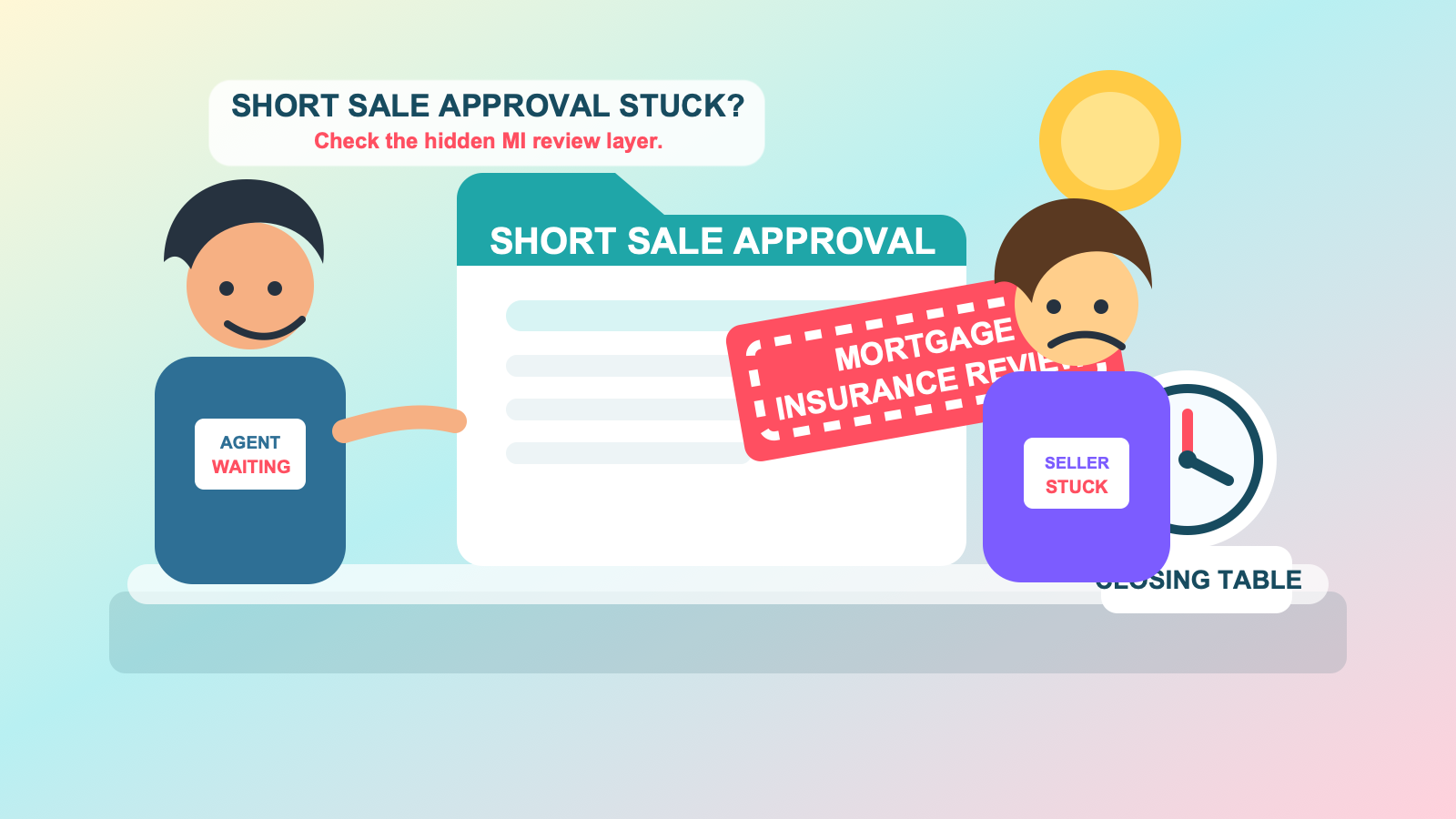
Short Sale Approval Delayed by Mortgage Insurance?
Related topic hub: Short Sale Approval Delays. It breaks down lender delays, document loops, valuation problems, mortgage insurance review, and next steps.
Fast Answer: Mortgage Insurance Short Sale Delays
Mortgage insurance can delay a short sale because the insurer may have to approve the lender's loss before the final short sale approval is released. The fastest path is to confirm whether MI review is active, identify the exact missing condition, and send one clean response package through the lender or short sale negotiator.
What To Do Next If MI Is Holding Approval
- Ask the lender whether the file is in mortgage insurance review or still waiting for investor approval.
- Get the exact missing condition in writing so the response does not turn into a guessing game.
- Keep the buyer, listing agent, and short sale negotiator aligned on timing before the contract loses momentum.
A short sale approval can feel painfully close, then mortgage insurance steps in and everything stalls. If your short sale approval is delayed by mortgage insurance, the goal is to identify the missing review issue fast, give the insurer what it needs, and keep the buyer from drifting away. The buyer is ready. The seller is packed. The agent is refreshing the inbox like it owes them money.
Then the short sale approval does not show up.
Even worse, the bank says the file is "still under review," even though everyone thought the review was basically done. This is one of those moments where a short sale can feel less like a real estate transaction and more like a mystery novel with too many characters.
One of the hidden characters? Mortgage insurance.
Mortgage insurance can be the extra approval layer that slows down a short sale, surprises the agent, and frustrates the seller. The servicer may appear to be the decision-maker, but if mortgage insurance is attached to the loan, the file may need another set of eyes before the approval letter is issued.
That does not mean the deal is doomed. It does mean the file needs to be handled carefully, because timing, documentation, and negotiation strategy matter.
The Bank May Not Be the Only Party Reviewing the File
In many short sales, the mortgage servicer collects the documents, orders the valuation, reviews the offer, and communicates with the agent or short sale negotiator. That makes it easy to assume the servicer has full authority to approve or deny the deal.
Sometimes they do.
Sometimes they do not.
If the loan has mortgage insurance, the mortgage insurance company may have a financial stake in the loss. That means they may need to review the proposed short sale terms before the servicer can issue final approval.
This is where sellers and agents often get blindsided. The file may move through document review, valuation review, buyer offer review, and investor review, only to hit another checkpoint near the finish line.
That checkpoint can affect:
The acceptable payoff amount
Seller contribution requests
Promissory note demands
Closing cost approvals
Commission approval
Whether the file can close before a foreclosure sale date
This is why experienced short sale assistance is not just about submitting paperwork. It is about knowing where approval authority really sits and anticipating what may slow the deal down.
Why Mortgage Insurance Can Create Delays
Mortgage insurance delays usually happen because the MI company is trying to limit its own loss.
From their perspective, a short sale is not just a seller asking the bank to accept less than the full balance. It may also be a claim event. The mortgage insurance company may be asked to cover part of the lender's loss, so they want to review whether the proposed short sale makes sense.
That review can take time, especially if the file is missing details or the numbers are unclear.
Common delay triggers include:
A purchase price below the valuation range
Unusual closing costs on the estimated settlement statement
Excessive credits to the buyer
A seller financial package that does not clearly show hardship
Missing income, bank statement, or tax documentation
A buyer who keeps extending without updated proof of funds
Last-minute changes to commissions, fees, or closing dates
This is where good short sale processing makes a real difference. A clean file does not guarantee instant approval, but a messy file almost guarantees extra questions.
And in short sales, extra questions are where timelines go to take a nap.
The Seller Contribution Surprise
One of the biggest mortgage insurance surprises is the seller contribution request.
A seller may believe the short sale has been accepted, then suddenly hear that the mortgage insurance company wants money at closing or a promissory note. That can feel unfair, especially when the seller is already in hardship.
But the request is not random. The MI company may be trying to reduce the claim amount or recover part of the loss directly from the seller.
That does not mean the seller should automatically agree.
A skilled short sale negotiator may be able to challenge the request, explain the seller's hardship, document limited financial ability, or negotiate the demand down. In some cases, the request can be reduced. In others, it may become part of the final approval terms.
The key is not to panic when the request appears. The key is to respond with documentation, not emotion.
Why Agents Need to Ask About MI Early
For real estate agents, mortgage insurance is one of those details that can quietly affect the entire transaction. If the agent does not know MI approval may be required, they may accidentally overpromise timelines to the buyer, seller, title company, or cooperating agent.
That creates pressure later.
A better approach is to build the possibility into the strategy from the beginning. When the file is opened, the agent or short sale specialist should look for signs that additional approval parties may be involved.
That may include:
Asking the servicer whether MI review is required
Watching for investor or insurer language in updates
Preparing the buyer for possible extensions
Keeping the seller's financials current
Making sure the estimated settlement statement is clean
Avoiding unnecessary fees that could trigger objections
This is one reason Crisp Short Sales focuses on helping real estate agents close short sales faster. Short sales are not just about getting an offer. They are about managing the approval path from start to finish.
What Sellers Should Do If the File Is Stuck
If your short sale seems stuck and no one can explain why, mortgage insurance may be one possible reason.
The first step is to get clarity. Ask whether the file is with the servicer, investor, mortgage insurance company, or another approval party. The answer matters because "under review" is not specific enough.
The next step is to make sure the file is complete and current. If updated pay stubs, bank statements, hardship details, or buyer documents are needed, delays can compound quickly.
Sellers should also be careful about ignoring communication from the servicer. A short sale file can be closed or delayed if requested documents are not returned on time. The bank may not wait politely forever, even if the seller feels like the bank has been taking its sweet time.
If there is already a foreclosure date, timing becomes even more important. The earlier you start the short sale process, the better the chances of managing extra approval layers before the timeline gets tight.
The Bottom Line
Mortgage insurance can delay a short sale because it may add another decision-maker to the approval process.
That does not make approval impossible. It just means the file needs to be positioned correctly. Agents need to understand who is reviewing the deal. Sellers need to keep documentation current. Buyers need to be prepared for possible extensions. And the numbers need to make sense before the file reaches the final approval stage.
A short sale can already have enough moving parts. Mortgage insurance adds one more.
The good news? Once you know it may be there, you can plan around it. And in short sales, planning around the hidden delay is often what keeps the deal alive.

Short Sale Relocation Assistance Before Foreclosure: Timing Matters
Foreclosure date coming up? See how short sale relocation assistance works, what mistakes can cost sellers the check, and why timing matters.
The foreclosure date is on the calendar, the moving boxes are not packed, and the seller is wondering the same thing at 2:13 a.m.: “If I do a short sale, can I still get help with moving money?”
Related topic hub: Foreclosure Urgency. It groups timing-sensitive posts for sale dates, foreclosure pressure, lender postponements, and short sale options.
Short Sale Relocation Assistance Hub
Relocation assistance is one of the most click-worthy short sale topics because the reader wants to know whether money may be available before moving. This hub connects the strongest posts on incentive programs, eligibility, timing, and foreclosure pressure.
- Can You Get Relocation Money in a Short Sale?
- Short Sale Incentive Programs: Get Paid to Move
- Short Sale Relocation Incentives: Who Gets Paid?
- What Is Relocation Assistance in a Short Sale?
- How Relocation Incentives Work in a Short Sale
- Can You Do a Short Sale Without Missing Payments?
- Georgia Short Sales: Avoid Foreclosure Earlier
- Utah Foreclosures Rising: When Short Sales Help
- Pennsylvania Foreclosures: When Short Sales Help
Ask about relocation assistance before approval terms are final
That question matters because relocation assistance is often not just about whether a seller qualifies. It is about timing, cooperation, documentation, and whether the short sale closes before the lender’s foreclosure process runs out the clock.
And yes, in the right situation, a seller may be able to receive relocation assistance through an approved short sale. But this is not magic money from the real estate fairy department. It has rules. It has deadlines. And if the file is handled casually, that check can disappear before anyone knows what happened.
The Window Can Close Faster Than Sellers Expect
A short sale is a negotiated settlement with the mortgage servicer or investor. The lender agrees to accept less than the full loan balance because it may be a better outcome than foreclosure.
Relocation assistance is separate. It is a payment some lenders or investors allow at closing to help the homeowner move after completing the approved short sale. For example, Fannie Mae’s current servicing guidance says eligible owner-occupant borrowers in a completed Fannie Mae short sale may receive relocation assistance, subject to specific exclusions and conditions.
The key phrase is “completed short sale.”
If the foreclosure sale happens first, there is no short sale closing. No closing usually means no relocation payment. That is why sellers who want to protect the possibility of relocation assistance should ask for short sale help as early as possible, not after the auction notice has already started breathing down everyone’s neck.
The Seller Usually Has to Cooperate All the Way Through
Relocation assistance is typically tied to cooperation. That means the seller needs to provide documents, allow access, sign forms, maintain communication, and move out as agreed.
Common seller mistakes that can put relocation money at risk include:
Waiting too long to submit the short sale package
Ignoring servicer document requests
Refusing reasonable showings
Letting the property deteriorate
Moving out without a plan
Assuming the buyer, agent, or title company controls the incentive
That last one is big. Relocation assistance is usually approved by the lender, investor, or servicer. It should appear in the written short sale approval and on the closing statement. If it is not confirmed in writing, do not treat it like guaranteed money.
Agents Should Ask About It Early
For agents, relocation assistance is not just a seller benefit. It can keep the file alive.
A seller who is overwhelmed, broke, and facing foreclosure may stop cooperating because the entire process feels pointless. When they understand that a successful short sale may provide moving funds, they often stay more engaged.
That does not mean agents should promise a payout. They should not. But they can ask the right questions early:
Is this an owner-occupied property?
Who owns or insures the loan?
Is there an active foreclosure sale date?
Has the seller already received relocation assistance from another source?
Will the servicer allow relocation funds in this file?
Will the incentive be listed in the approval letter?
This is where a strong short sale negotiator earns their keep. Crisp Short Sales helps with short sale assistance for agents and homeowners by tracking lender requirements, requesting available incentives, and making sure the approval terms are clear before closing.
The Foreclosure Date Changes the Strategy
If there is no foreclosure date yet, the strategy is usually straightforward: build the strongest short sale file possible and push for approval.
If there is already a sale date, the strategy becomes more urgent. The short sale team may need to request a foreclosure postponement, show that the property is actively listed, document the offer status, and prove that the lender has a better path than foreclosing.
This is where sellers get into trouble when they wait. A lender may be more willing to review a short sale when there is enough time to evaluate the hardship, order a valuation, review the buyer’s offer, negotiate liens, and approve the settlement. When the sale date is only days away, everyone is working with less oxygen.
Can a foreclosure sale be postponed? Sometimes. Is it guaranteed? Absolutely not. That is why the safest move is to start the short sale process before the timeline becomes an emergency.
What Sellers Should Do Right Now
If a seller is hoping for relocation assistance, the first step is not guessing. It is getting the file organized.
They should gather:
Mortgage statement
Hardship explanation
Pay stubs or income documentation
Bank statements
Tax returns if requested
HOA information
Any foreclosure notices
Listing agreement and buyer offer if available
They should also ask the servicer directly whether relocation assistance may be available for their loan type. Some investors have published rules. Some lenders have internal programs. Some files qualify, some do not.
The important thing is to ask early and document everything.
Bottom Line
Short sale relocation assistance can be a meaningful lifeline for a seller who needs to move before foreclosure. It may help cover deposits, moving trucks, utility setup, or the basic costs of getting a fresh start.
But it is not automatic. It depends on the investor, the servicer, the property occupancy, the seller’s cooperation, the approval terms, and whether the short sale actually closes.
If foreclosure is already in motion, timing becomes the whole game. The sooner the seller gets organized, the better the chance of preserving options, negotiating clearly, and avoiding the classic short sale tragedy: finding out help was available after the clock already ran out.

The Hidden Deadline Most Homeowners Miss Before Starting a Short Sale
The biggest mistake most homeowners make during financial hardship isn’t missing a payment.
It’s waiting too long to ask for help.
By the time many sellers finally start researching short sales, they’re already staring at a foreclosure sale date, nonstop lender letters, and a timeline that suddenly feels impossible to stop. What surprises people most is that there’s usually a hidden deadline long before the actual foreclosure auction — a point where options begin shrinking fast.
The earlier you act, the more control you keep.
And in many cases, homeowners who start the process sooner have dramatically better odds of avoiding foreclosure entirely, protecting future home-buying ability, and even qualifying for relocation assistance at closing.
The “Invisible” Timeline Most Sellers Don’t Realize Exists
A foreclosure sale date isn’t where the pressure begins. It’s where the pressure becomes unavoidable.
Long before that happens, lenders are already tracking:
- Missed payments
- Loan delinquency timelines
- Document submission deadlines
- Valuation orders
- Investor approval windows
- Foreclosure attorney scheduling
- Internal escalation milestones
Once certain internal deadlines pass, lenders become less flexible. Files move faster toward foreclosure departments, negotiators become harder to reach, and approval windows tighten.
That’s why homeowners who wait until “the last minute” often discover there’s far less time remaining than they thought.
Why Waiting Hurts Your Short Sale Chances
Many homeowners delay because they’re hoping something changes:
- The market improves
- Income increases
- The lender offers a modification
- A buyer appears immediately
- They somehow catch back up
Unfortunately, lenders usually don’t pause their timeline while homeowners figure things out.
A successful short sale requires time for:
- Gathering documents
- Completing hardship paperwork
- Valuation reviews
- Offer negotiations
- Investor approval
- Title work
- Closing coordination
That’s where experienced Crisp Short Sales teams can make a major difference. A professional short sale coordinator and short sale negotiator can often help organize the process early before the situation becomes urgent.
The Best Time to Start a Short Sale
Most homeowners assume they need to wait until foreclosure is imminent before beginning.
That’s usually the opposite of what works best.
The strongest short sale files often begin:
- After the first few missed payments
- When hardship becomes long-term
- Before the foreclosure attorney gets heavily involved
- Before a sale date is finalized
Starting early creates leverage.
It gives time to:
- Market the property properly
- Attract stronger offers
- Negotiate more effectively
- Resolve title or lien issues
- Communicate consistently with the lender
If you wait until the final weeks before foreclosure, every delay becomes dangerous.
What Happens If You Wait Too Long?
Every lender is different, but late-start files commonly run into problems like:
1. Incomplete Review Windows
The lender simply doesn’t have enough time to fully review and approve the file before the foreclosure date arrives.
2. Expedited Foreclosure Departments
Once files escalate internally, some departments become much harder to work with.
3. Buyers Walk Away
Investors and retail buyers often lose patience if timelines become chaotic or uncertain.
4. Missed Relocation Incentives
Some sellers may qualify for relocation assistance programs during a short sale, but delayed files can reduce those opportunities.
5. Increased Stress
This may be the biggest one. Last-minute short sales often become emotional emergencies instead of organized solutions.
The Good News: Foreclosure Isn’t Always Immediate
A lot of homeowners assume once they receive legal notices, it’s already too late.
That’s not always true.
Many short sales are approved surprisingly close to scheduled foreclosure dates — but those situations require fast action, complete documentation, and experienced communication with the lender.
That’s why homeowners often seek professional short sale help once they realize the process involves much more than simply listing the property.
Why Organization Matters So Much
Lenders are looking for complete, organized files.
Missing paperwork, delayed responses, or incomplete submissions can stall approval for weeks.
An experienced team handling:
- lender communication,
- document collection,
- buyer coordination,
- and short sale processing
can often reduce delays that otherwise kill deals.
That’s especially important for agents trying to manage multiple listings at once. Many Realtors partner with outside professionals who specialize in helping real estate agents close short salesfaster so the transaction doesn’t consume their entire schedule.
Homeowners Still Have More Options Than They Think
The earlier you explore solutions, the more likely you are to:
- avoid foreclosure,
- negotiate favorable terms,
- preserve future borrowing ability,
- and reduce overall stress.
Many homeowners are shocked to discover they had options available months earlier that disappeared simply because nobody explained the timeline properly.
Starting early doesn’t commit you to anything.
It simply gives you time to understand:
- your lender’s process,
- your available options,
- and what path makes the most sense for your situation.
Don’t Wait for the “Perfect Time”
There usually isn’t one.
The homeowners who have the smoothest short sales are rarely the ones who waited until the foreclosure clock hit panic mode. They’re the ones who addressed the problem early while options still existed.
If you’re already falling behind, receiving lender notices, or worried foreclosure may eventually happen, now is the time to ask questions and gather information.
Even one extra month can make a massive difference in whether a short sale succeeds.
If you want to explore your options or start the
Learn more about how we help real estate agents close short sales faster.
Start the short sale process. Getting organized early may be the single most important decision you make.
Why Investors Lose Money on Short Sales Even When the Deal Looks Great

You finally found it.
The listing looks underpriced. The comps support the value. The photos show "light cosmetic updates needed." The seller is motivated. On paper, it looks like a home run investment deal.
Then the short sale approval drags on for four months.
The lender counters higher than expected. The title search uncovers surprise liens. The property condition gets worse while waiting. The seller stops cooperating. Suddenly, the "great deal" barely breaks even — or worse, becomes a money pit.
This happens to investors every day.
The truth is, profitable short sales are rarely won by the investor with the lowest offer or biggest rehab budget. They’re usually won by the investor who understands the process best and works with the right short sale specialist behind the scenes.
Here are the biggest reasons investors lose money on short sales — even when the deal initially looks incredible.
1. They Underestimate the Timeline
One of the fastest ways investors lose money is assuming a short sale will close quickly.
Unlike a traditional transaction, the bank must approve the payoff before the sale can happen. That means the lender is reviewing:
- Seller hardship
- Financial documents
- Property value
- Investor guidelines
- Net proceeds
- Liens and title issues
- Purchase contract terms
If any piece is incomplete or submitted incorrectly, the process can stall for weeks.
Many investors line up contractors, hard money, holding costs, or resale plans before approval is finalized. Then delays start stacking up.
A professional short sale negotiator can dramatically reduce these delays by ensuring the package is complete from the beginning and proactively managing lender communication throughout the file.
That’s one reason many investors choose to work with experts who specialize in helping investors navigate complex short sales before the deal becomes expensive.
2. Hidden Liens Destroy the Numbers
A short sale might appear profitable until title work comes back.
Suddenly there’s:
- A second mortgage
- HOA debt
- Tax liens
- Contractor liens
- Judgments
- Utility balances
- IRS issues
Now the lender wants more money. The title company raises concerns. Negotiations become more difficult. Sometimes junior lienholders refuse to cooperate entirely.
Experienced short sale coordinators know how to identify these issues early and structure negotiations around them before the investor wastes months chasing a dead deal.
Without that preparation, investors often spend valuable time, inspections, and due diligence costs on deals that never close.
3. They Trust Zillow Repair Estimates
This one gets investors constantly.
Photos lie.
Listings often downplay condition issues, especially in distressed situations. Vacant homes can deteriorate rapidly during the short sale process itself.
By the time approval arrives, the property may now have:
- Mold
- Water intrusion
- Theft or vandalism
- HVAC damage
- Roof leaks
- Foundation problems
- Code violations
The longer the process drags on, the higher the risk.
Savvy investors budget conservatively and expect surprises. They also understand that strong short sale processing can shorten timelines and reduce the chance of the property sitting vacant for months deteriorating further.
4. Banks Care About Net Numbers — Not Investor Margins
Many investors assume if they submit a low offer with solid comps, the bank will simply accept reality.
Unfortunately, banks don’t always operate logically from an investor’s perspective.
Lenders rely heavily on:
- Broker price opinions (BPOs)
- Automated valuation models
- Internal investor guidelines
- Mortgage insurance requirements
- Investor restrictions
- Loss mitigation formulas
That means the bank may counter far above what actually makes sense for an investor.
This is where an experienced short sale processor becomes critical. Strong negotiators know how to challenge inflated valuations, dispute bad BPOs, provide repair estimates properly, and build a compelling value argument to the lender.
Without that guidance, many investors overpay just to "save the deal" — and wipe out their profit margin before renovations even begin.
5. Sellers Sometimes Stop Cooperating
Short sales are emotional.
Many homeowners are overwhelmed, embarrassed, stressed, or simply exhausted by the process. Some stop returning calls halfway through. Others delay paperwork for weeks. Some decide not to sell at all.
Every delay increases risk for the investor.
An organized system for communication, updates, document collection, and seller management is one of the most overlooked parts of successful short sale investing.
That’s why investors often rely on professional sale assistance and lender coordination services instead of trying to manage the entire process themselves.short
Keeping sellers engaged throughout the transaction can be the difference between a profitable closing and months of wasted effort.
6. They Ignore Carrying Costs During Delays
Even when a deal eventually closes, the numbers can quietly deteriorate during the waiting period.
Investors often forget to account for:
- Rising interest rates
- Insurance
- Taxes
- Utilities
- Hard money extension fees
- Contractor price increases
- Market shifts
- Opportunity cost
A deal projected to make $45,000 can slowly shrink to $15,000 or less if approval takes too long.
That’s why speed matters so much in short sales.
Efficient short sale negotiation is not just about getting approved — it’s about protecting the economics of the investment while the file is still alive.
7. They Try to Handle the Entire Negotiation Themselves
Some investors are excellent at acquisitions, construction, and disposition — but short sale negotiations are their own skill set entirely.
Every lender has different requirements.
Every negotiator handles files differently.
Every investor guideline changes over time.
Trying to learn everything mid-deal can become expensive fast.
Many successful investors eventually realize it’s more profitable to outsource the negotiation side completely and focus on what they do best: finding deals and closing transactions.
If you’re looking to start the short sale process on an investment property, having experienced guidance early can help prevent expensive surprises later.
Final Thoughts
Short sales can absolutely create incredible opportunities for investors.
But the investors who consistently profit are usually the ones who understand that the negotiation process itself is just as important as finding the property.
The best deals are not always the cheapest deals.
They’re the deals that actually close cleanly, close efficiently, and close with the profit margin still intact by the time the investor reaches the finish line.

Why Banks Keep Asking for the Same Documents in a Short Sale
You already sent the bank your pay stubs. Then they ask again.
Related topic hub: Short Sale Approval Delays. It breaks down lender delays, document loops, valuation problems, mortgage insurance review, and next steps.
You uploaded the bank statements three weeks ago. Now they want “updated versions.”
The hardship letter? Sent twice already.
At some point, every homeowner and real estate agent handling a short sale starts asking the same question:
“Why does the lender keep requesting the same documents over and over again?”
It feels repetitive, frustrating, and honestly a little ridiculous. But in most cases, there’s actually a reason behind it — and understanding why this happens can help prevent unnecessary delays, missed foreclosure deadlines, and failed approvals.
The truth is, short sale processing is heavily document‑driven. Banks are constantly re‑reviewing files, updating timelines, and refreshing financials throughout the negotiation process. If even one item expires or becomes inconsistent, the lender may stop the review completely until updated paperwork is submitted.
That’s why experienced agents often rely on a professional short sale processor and negotiation team to stay ahead of these requests before they become major problems.
## Most Short Sale Documents Expire Faster Than People Realize
One of the biggest misconceptions in a short sale is that once documents are submitted, they’re good for the entire transaction.
Unfortunately, that’s rarely how lenders operate.
Most banks have internal expiration timelines for financial documents, including:
- Bank statements
- Pay stubs
- Tax returns
- Profit & loss statements
- Hardship letters
- Listing agreements
- Purchase contracts
- HUDs and settlement statements
Some lenders treat documents as “stale” after just 30 days. Others allow 60 or 90 days depending on investor guidelines.
That means if the negotiator, underwriter, valuation department, or mortgage insurer takes too long reviewing the file, the entire package may need to be refreshed before approval can continue.
And yes — sometimes that means resending documents that were already submitted perfectly the first time.
## Different Departments Review the File at Different Times
Another reason documents get requested repeatedly is because multiple departments inside the lender may touch the file during the short sale process.
The negotiator reviewing the hardship package is often not the same person reviewing the valuation. The mortgage insurer may have separate conditions. Investor approval may trigger additional underwriting reviews.
Sometimes the lender transfers the file to a new negotiator entirely.
When that happens, requests can restart almost from scratch.
This is one reason many real estate agents outsource short sale coordination rather than trying to manage every lender update themselves while also handling inspections, showings, contracts, and client communication.
A good short sale coordinator keeps the file organized so updated documents can be delivered immediately instead of losing another two weeks waiting on sellers to resend paperwork.
## Small Inconsistencies Can Trigger New Requests
Banks are extremely sensitive to inconsistencies during short sale review.
If one pay stub shows overtime income that wasn’t mentioned previously, the lender may ask for clarification.
If a bank statement suddenly shows a large deposit, they may request sourcing documentation.
If the seller changes jobs, opens a new account, or misses a payment during review, the lender may want updated financials to reassess hardship eligibility.
Even something minor — like a missing signature or an unreadable PDF upload — can trigger another document request cycle.
This is where professional short sale processing becomes less about “paperwork” and more about quality control.
An experienced short sale specialist knows how lenders review files and can often spot issues before submission, reducing unnecessary conditions and delays later.
## Foreclosure Timelines Don’t Pause Just Because Documents Are Missing
One of the biggest dangers with repeated document requests is timing.
Many sellers assume the lender will simply “work with them” indefinitely while paperwork gets updated. But foreclosure departments usually operate independently from loss mitigation.
That means the foreclosure clock may continue moving while the short sale file sits incomplete.
We’ve seen situations where:
- Sellers waited too long to provide updated documents
- Negotiators went silent for weeks
- Expired financials delayed approval review
- Foreclosure sale dates were scheduled before the file was fully escalated
This is why homeowners often reach out for short sale help early in the process instead of waiting until the foreclosure timeline becomes critical.
The earlier the file is stabilized and updated consistently, the more options usually remain available.
## Why Experienced Short Sale Negotiators Stay Obsessively Organized
The best short sale negotiators aren’t just good at talking to banks.
They’re good at preventing problems before they happen.
That means:
- Tracking document expiration dates
- Following up proactively with lenders
- Keeping sellers updated on upcoming refreshes
- Reviewing submissions for missing items
- Maintaining complete file history
- Resubmitting updated packages quickly when needed
A well‑managed short sale file moves differently than a reactive one.
Instead of scrambling every time the lender requests something, the file stays prepared for the next stage of review.
That can mean faster approvals, fewer surprises, and a much smoother experience for everyone involved — including the buyer waiting on the transaction.
## The Repeated Requests Are Annoying — But Usually Normal
If you’re currently dealing with a lender asking for updated paperwork again, you’re definitely not alone.
It doesn’t always mean something is wrong with the file.
In many cases, it simply means the short sale is still actively moving through lender review channels and the bank needs refreshed documentation before issuing final approval.
The key is staying organized, responsive, and proactive before delays snowball into larger problems.
Because in the short sale world, momentum matters.
And the faster updated documents get handled, the better chance the file has of making it all the way to the closing table.

Why Banks Suddenly Stop Responding During a Short Sale
One day the short sale is moving along normally. The negotiator is emailing. Documents are being requested. The seller finally feels like progress is happening.
Related topic hub: Short Sale Approval Delays. It breaks down lender delays, document loops, valuation problems, mortgage insurance review, and next steps.
Then… nothing.
No calls back. No email responses. Weeks go by. The foreclosure date gets closer. Buyers start getting nervous. Agents begin wondering if the file fell into a black hole.
Unfortunately, this scenario happens constantly in short sales — especially when no experienced short sale negotiator is actively pushing the file forward.
The good news? Silence from the bank usually does not mean the deal is dead. But it does mean someone needs to know how to keep pressure on the process before the transaction collapses completely.
### Why Banks Suddenly Go Quiet During Short Sale Processing
Banks rarely explain what’s happening internally, which creates enormous frustration for sellers and agents. In reality, several things may be causing the delay:
- The file was reassigned to a new negotiator
- The lender requested documents that were never uploaded correctly
- The investor is reviewing value disputes
- Mortgage insurance approval is pending
- The foreclosure department and loss mitigation department are not aligned
- The file was marked incomplete internally
- The lender is overloaded with files
Sometimes the issue is as simple as one missing paystub. Other times, the negotiator handling the file has left the company entirely and nobody updated the parties involved.
This is where experienced short sale processing support becomes critical. Most stalled files are not impossible to close — they simply require consistent follow-up and escalation.
### The Biggest Mistake Sellers and Agents Make
When banks stop responding, many people wait too long before taking action.
A seller may assume: “The bank must still be reviewing everything.”
An agent may think: “I already emailed them twice, so now we just wait.”
Meanwhile, foreclosure timelines continue moving forward behind the scenes.
One of the biggest misconceptions in short sale processing is that silence equals progress. In reality, inactive files often become the lowest priority inside lender systems.
Experienced short sale coordinators understand that files frequently need:
- Escalation requests
- Supervisor involvement
- Updated authorization forms
- Re-submission of documents
- Value disputes
- Internal department transfers
Without active management, files can sit untouched for weeks.
### Foreclosure Deadlines Don’t Pause
This is the part homeowners often do not realize.
Even while the short sale is under review, the foreclosure process may continue moving forward unless the lender specifically postpones it.
That means:
- Auction dates can still approach
- Attorney fees can continue increasing
- Sellers may lose valuable time to relocate properly
- Buyers can walk away due to uncertainty
This is why many distressed homeowners seek short sale assistance early in the process instead of waiting until the lender becomes unresponsive.
The earlier the file is stabilized, the more options everyone usually has.
### Why Some Short Sales Stay Active While Others Collapse
The difference is often communication and persistence.
Successful short sales usually have someone:
- Following up constantly
- Tracking lender deadlines
- Confirming documents were received
- Escalating stalled files
- Monitoring foreclosure activity
- Managing buyer expectations
- Keeping sellers informed
Failed short sales often involve:
- Weeks without lender contact
- Missing paperwork
- Buyers losing confidence
- Agents overwhelmed with lender calls
- Nobody actively driving the process
Banks handle thousands of distressed files simultaneously. Files with organized, proactive communication generally move faster than files sitting quietly in the system.
### Buyers Get Nervous Fast
Another hidden danger of lender silence is buyer fatigue.
Many buyers initially agree to wait for a short sale approval, but long periods without updates create uncertainty:
- Will the bank approve the price?
- Is foreclosure about to happen?
- Are there other liens involved?
- Is the seller cooperating?
- Is the deal going anywhere?
Once buyers lose confidence, they often move on to another property.
That creates an even bigger problem because restarting a short sale with a new buyer can sometimes mean:
- New lender approvals
- Updated valuations
- Revised timelines
- Additional foreclosure pressure
An experienced short sale specialist working alongside real estate agents helps maintain communication with all parties so buyers stay engaged while negotiations continue.
### Sometimes the Bank Is Waiting on the Investor
Here’s another major reason delays happen in 2026.
Many mortgage servicers do not make the final short sale decision themselves. Instead, the loan may be owned by:
- Fannie Mae
- Freddie Mac
- FHA
- VA
- Private investors
- Mortgage insurance companies
That means the servicer may appear unresponsive because they are waiting on approvals from multiple parties.
This is especially common when:
- The offer price is disputed
- The seller has multiple mortgages
- There are liens or judgments
- The investor requests additional review
A knowledgeable short sale negotiator understands how these approval layers work and when escalation makes sense versus when patience is actually required.
### What Homeowners Should Do If the Bank Goes Silent
If communication suddenly stops during a short sale, homeowners should:
1. Ask for a full status update immediately
2. Verify all lender‑requested documents were submitted
3. Confirm whether foreclosure activity is still progressing
4. Make sure someone is actively following up weekly
5. Keep financial documents updated
6. Avoid assuming “no news is good news”
Most importantly, do not wait until days before foreclosure to seek help.
The earlier problems are identified, the easier they usually are to solve.
### Short Sales Still Close Every Day
Bank delays are frustrating, but they are also extremely common.
A quiet lender does not automatically mean the short sale failed.
In many cases, the file simply needs stronger follow‑up, better escalation, updated documentation, or experienced coordination to get things moving again.
That’s why homeowners, investors, and agents across the country continue relying on professional short sale processors and negotiators to keep difficult files alive — especially when lender communication starts breaking down.
The key is staying proactive before the timeline becomes irreversible.
Why Banks Suddenly Counter at Full Price on Short Sales
Bank demanding too much on your short sale? Here’s why lenders are countering high in 2026—and how experienced negotiators keep deals alive.
A few years ago, getting a short sale approved often felt like a race against time. Today, many agents are dealing with a completely different problem: the bank finally responds… and the counteroffer is shockingly high.
Related topic hub: BPO and Short Sale Pricing. It covers high BPOs, counteroffers, valuation disputes, offer strategy, and pricing problems.
You list a property based on condition, neighborhood activity, and what buyers are actually willing to pay. The seller is desperate to avoid foreclosure. The buyer submits a solid offer. Everyone expects some negotiation.
Then the lender comes back wanting full list price—or sometimes even more.
Suddenly the deal that looked workable starts falling apart.
This is becoming increasingly common in 2026, and it’s frustrating both agents and homeowners nationwide. But there’s usually a reason behind it, and understanding what’s happening behind the scenes can help prevent good short sale deals from collapsing unnecessarily.
## Why Banks Are Pushing Higher Values Again
Most lenders are leaning heavily on automated valuation models right now. In many cases, they are not physically inspecting properties before assigning value.
That becomes a huge problem when the home needs serious repairs.
A lender’s valuation software may compare a distressed property to renovated homes nearby and completely ignore things like:
- Mold damage
- Foundation problems
- Water intrusion
- Vacant property deterioration
- Deferred maintenance
- Outdated interiors
- Failed HVAC or roofing systems
To the bank’s computer system, the property may appear worth far more than reality.
This is especially common in markets where prices increased rapidly over the past few years. Some lenders are still anchoring valuations to peak market conditions even while buyer demand has softened.
The result? Unrealistic counteroffers that threaten to kill otherwise legitimate short sales.
## Why This Creates Major Problems for Sellers
Most homeowners pursuing a short sale are already under enormous pressure.
They’re behind on payments, facing foreclosure deadlines, juggling relocation plans, or dealing with major financial hardship. The last thing they need is a lender demanding a price the market simply will not support.
Unfortunately, many sellers assume the bank’s number must be accurate.
It often isn’t.
This is where experienced <a href="/how-we-help">short sale help</a> becomes critical. A lender’s initial valuation is not always final, and many approvals can still be negotiated successfully with the right documentation and escalation strategy.
## What Skilled Short Sale Negotiators Actually Do
A strong short sale negotiator does much more than submit paperwork.
A major part of successful short sale processing involves challenging inflated lender valuations with evidence that the bank cannot easily ignore.
That may include:
- Contractor repair estimates
- Interior property photos
- Updated comparable sales
- Market trend analysis
- Buyer demand feedback
- Inspection reports
- Local inventory conditions
Sometimes the lender simply needs a clearer picture of the property’s actual condition.
Other times, the file must be escalated beyond the initial negotiator to management or investor review.
This is why experienced <a href="/who-we-serve">short sale specialists working alongside real estate agents</a> can make such a significant difference. Many deals that appear “dead” at first can still be salvaged with the proper approach.
## Why Timing Matters More Than Ever
One of the biggest mistakes agents make is waiting too long to push back on unrealistic values.
Every week that passes creates additional risk:
- Buyers lose patience
- Foreclosure dates approach
- Utility shutoffs occur
- Sellers emotionally disengage
- Market conditions shift
The faster valuation disputes are addressed, the better the odds of keeping the transaction alive.
This is one reason short sale coordination has become increasingly important. Organized communication and proactive lender follow-up often determine whether the file closes or quietly dies in someone’s inbox.
## The Hidden Problem Nobody Talks About
Many lenders are also trying to reduce investor losses after years of volatile pricing.
In some situations, negotiators are under internal pressure to recover every possible dollar—even when the market does not support the valuation.
That means agents are now seeing:
- Less flexibility
- More documentation requests
- Longer review timelines
- Additional appraisal disputes
- Multiple investor reviews
This can create the illusion that the lender is being unreasonable for no reason.
In reality, many negotiators are operating inside stricter internal guidelines than they were several years ago.
That does not mean approvals are impossible. It simply means the file needs to be prepared more strategically from the beginning.
## What Agents Can Do Right Now
If you’re listing a potential short sale in today’s market, preparation is everything.
Before the offer is even submitted:
- Document all property defects
- Gather contractor bids early
- Take extensive interior photos
- Prepare realistic comparable sales
- Set seller expectations properly
- Anticipate valuation disputes
The smoother and more organized the package is upfront, the easier it becomes to negotiate when the lender pushes back later.
And most importantly, do not assume a lender counter is final.
Many successful short sale approvals involve multiple rounds of negotiation before reaching acceptable terms.
## Homeowners Still Have Options
For distressed homeowners, receiving an unrealistic lender counteroffer can feel devastating. But it does not necessarily mean the short sale is over.
In many cases, the issue is simply that the lender lacks accurate information about the property or current market conditions.
That’s why homeowners facing foreclosure should seek experienced <a href="/start-short-sale">short sale assistance before the foreclosure timeline accelerates</a>. The earlier the process begins, the more flexibility exists to negotiate effectively.
Because once the foreclosure sale date gets too close, the bank gains leverage—and the available options shrink quickly.
The good news is that strong short sale files are still getting approved every single day.
But in 2026, preparation, negotiation skill, and persistence matter more than ever.

Can You Buy Another House After a Short Sale?
The short sale just closed. The moving trucks are gone, the stress is finally settling down, and for the first time in months, you can breathe again.
Then the next question hits:
“Did I just ruin my chances of ever owning another home?”
A lot of homeowners assume a short sale means they’re locked out of the housing market for years. That fear alone keeps many people from taking action early enough to avoid foreclosure. The truth is, most sellers are surprised to learn that a short sale is often far less damaging than a completed foreclosure — especially when handled correctly.
In many cases, homeowners can qualify for another mortgage much sooner than they think.
## A Short Sale Doesn’t Mean You’re “Done”
One of the biggest misconceptions about short sales is that they permanently destroy your ability to buy another property. That’s simply not true.
In fact, lenders, underwriters, and mortgage programs generally view a short sale much more favorably than a foreclosure, bankruptcy, or repossession. Why? Because a short sale usually shows that the homeowner took proactive steps to resolve the debt rather than walking away entirely.
That distinction matters.
Many homeowners who go through the short sale process are able to rebuild their credit, stabilize their finances, and purchase another home within a relatively reasonable timeframe.
The key is understanding how the timeline works and what lenders are looking for afterward.
## FHA, VA, and Conventional Loan Waiting Periods
This is where things get interesting — because the answer depends heavily on the type of loan you want next.
### FHA Loans
For many homeowners, FHA financing offers one of the quickest paths back into homeownership after a short sale.
In some situations, borrowers may qualify immediately after a short sale if:
- Payments were current before the sale
- The short sale was caused by a documented hardship
- Credit has otherwise remained stable
More commonly, FHA borrowers may face a waiting period of around 1–3 years depending on late payments and overall credit recovery.
### VA Loans
VA loans can also be surprisingly forgiving after a short sale.
Veterans and active-duty service members often have more flexibility than they expect, especially if:
- The VA loan itself was not defaulted heavily
- The borrower has re-established solid credit
- Income and debt ratios now look stable
A lot of agents don’t realize how important proper short sale documentation becomes for future VA underwriting. Working with an experienced U.S. Department of Veterans Affairs-related short sale specialist can help preserve future financing opportunities.
### Conventional Loans
Conventional financing typically carries the longest wait times after a short sale, often around 2–4 years depending on:
- Credit score recovery
- Mortgage late payments
- Debt-to-income ratio
- Cash reserves
- Overall financial profile
But even then, it’s still generally much better than the timelines associated with foreclosure.
## Your Credit Score Usually Starts Recovering Faster Than You Think
Here’s another thing homeowners are often shocked to discover:
The biggest credit damage usually happens before the short sale closes.
By the time most sellers contact a short sale negotiator or short sale processor, the mortgage has already become delinquent. The missed payments often impact credit more heavily than the actual closing itself.
Once the debt is resolved, many homeowners finally stop the financial bleeding and begin rebuilding.
That recovery process can accelerate surprisingly fast when sellers:
- Eliminate large mortgage debt
- Avoid foreclosure judgments
- Lower overall debt obligations
- Start rebuilding payment history
- Reduce financial stress
This is one reason many homeowners who delay action actually end up hurting themselves more in the long run.
## The Biggest Mistake Sellers Make After Closing
A lot of people think the hard part ends once the short sale closes.
In reality, the next 12–24 months are incredibly important.
Some sellers immediately max out credit cards, stop monitoring their credit, or assume they can’t qualify for financing anyway. That mindset can delay recovery unnecessarily.
Instead, homeowners should focus on:
- Keeping all current accounts paid on time
- Maintaining low credit card balances
- Avoiding unnecessary new debt
- Saving cash reserves
- Monitoring credit reports for errors
- Keeping stable employment and income
These small decisions often have a huge impact on how quickly someone can qualify for another mortgage.
## Why Documentation Matters More Than Most Agents Realize
This is where experienced short sale coordination becomes critical.
The way a short sale is documented can affect:
- Future underwriting reviews
- Deficiency balance treatment
- Credit reporting
- Mortgage eligibility timelines
- Debt forgiveness language
That’s one reason many agents choose to work with professionals who specialize in [short sale processing and lender negotiations](/how-we-help) rather than trying to navigate the file alone.
A cleanly negotiated short sale package can create far fewer headaches later for both the seller and future lenders.
## The Goal Isn’t Just Avoiding Foreclosure
A successful short sale isn’t only about getting out of a difficult situation today.
It’s about preserving future opportunities.
That includes:
- Protecting future homeownership options
- Limiting long-term credit damage
- Reducing legal and financial risk
- Giving families a path forward
For many sellers, a short sale becomes the turning point that allows them to eventually buy again under much healthier financial circumstances.
And for agents, understanding this bigger-picture outcome often helps sellers feel less trapped and more willing to take action early.
## Timing Matters More Than Most People Think
The earlier homeowners seek short sale help, the more options they usually have available.
Waiting until the week before foreclosure often limits flexibility, increases stress, and creates more underwriting complications later.
That’s why homeowners and agents alike often benefit from [starting the short sale process early](/start-short-sale), even if they’re still exploring options.
The sooner the file is organized, the easier it becomes to negotiate effectively with the lender and position the seller for a cleaner financial recovery afterward.
A short sale may feel like the end of one chapter.
But for many homeowners, it’s actually the beginning of the next one.
Why Short Sale Listings Are Getting Multiple Offers Again (And What Agents Must Do Differently) (Copy)
Getting multiple offers on a short sale? Don’t lose the deal. Learn how to structure and negotiate for faster approvals.
It’s happening again—and if you’re not ready for it, you’re going to lose deals you thought were solid.
You list a short sale. You price it right. You expect a slow trickle of interest… and instead, you get multiple offers within days. Sounds like a good problem, right?
Not exactly.
Because with short sales, more offers don’t always mean a better outcome. In fact, without the right short sale negotiation strategy, multiple offers can actually slow down approvals, confuse lenders, and kill deals entirely.
Let’s break down why this is happening—and what smart agents are doing differently right now to actually get these deals closed.
---
## Why Multiple Offers Are Back on Short Sales
The market is shifting, and short sales are quietly re-entering the spotlight.
We’re seeing:
- More homeowners falling behind on payments
- More properties priced below market to attract attention
- More investors aggressively targeting short sale opportunities
The result? Short sale listings are no longer being ignored—they’re being competed over.
But here’s the catch…
Unlike traditional listings, you’re not just negotiating with buyers. You’re negotiating with the bank—and they don’t care how many offers you have unless you present them the right way.
---
## The Biggest Mistake Agents Make With Multiple Offers
When multiple offers come in, most agents treat it like a standard deal:
- Call for highest and best
- Pick the strongest buyer
- Send it to the lender
Seems logical… but this is where things go sideways.
Short sale lenders don’t just want the highest offer—they want:
- A clean, realistic contract
- A buyer who will stick through the process
- A file that’s properly packaged and justified
If you rush to pick an offer without structuring it correctly, you risk:
- The lender rejecting the valuation
- The buyer backing out during delays
- Restarting the entire process months later
This is exactly where working with a short sale specialist changes everything.
---
## What Smart Agents Are Doing Differently
Agents who consistently close short sales right now are adjusting their approach in a few key ways:
### 1. They Pre-Screen Offers Like a Negotiator
Not all offers are equal in a short sale.
They’re looking for:
- Buyers with patience and realistic expectations
- Clean financing (or strong cash proof)
- Terms that will survive lender scrutiny
This is less about price—and more about approval probability.
---
### 2. They Structure the Offer for the Bank—Not Just the Seller
The winning offer is the one the lender will approve.
That means:
- Supporting the price with comps
- Avoiding unrealistic concessions
- Positioning the deal to align with the bank’s net expectations
If you’re unsure how to do this, this is exactly where short sale help can make or break your deal.
---
### 3. They Control the Narrative With the Lender
Submitting an offer isn’t enough—you need to tell the story behind it.
Banks want to know:
- Why this offer makes sense
- Why the property won’t sell for more
- Why approving now is in their best interest
This is where professional short sale negotiation becomes critical.
---
### 4. They Set Expectations With Buyers Early
Multiple-offer situations can create false urgency.
Smart agents are upfront:
- This is not a quick closing
- The bank controls the timeline
- The highest offer doesn’t always win
Setting expectations early prevents fallout later.
---
### 5. They Bring in a Short Sale Coordinator Before Problems Start
Most deals fall apart after the offer is accepted—not before.
By the time issues show up, it’s often too late.
That’s why experienced agents lean on a short sale coordinator from day one to:
- Package the file correctly
- Handle lender communication
- Keep the deal moving toward approval
If you want to see exactly how that process works, take a look at who we help most—this is where agents gain a serious edge.
---
## Why This Trend Isn’t Going Away
This isn’t a one-off situation.
As more homeowners face financial pressure, short sales will continue to rise—and so will competition around them.
But here’s the reality:
**The agents who treat short sales like regular listings will struggle.
The agents who adapt will dominate this space.**
---
## The Bottom Line
Multiple offers on a short sale sound great—but they come with a completely different set of rules.
If you:
- Choose the wrong buyer
- Structure the deal incorrectly
- Or fail to guide the lender properly
You’re not just risking one deal—you’re risking months of lost time.
The good news? You don’t have to figure this out alone.
If you have a short sale listing (or one coming up), the best move you can make is to start the short sale process the right way—before things get complicated.
Because in this market, the agents who win aren’t the ones with the most offers…
They’re the ones who know how to get them approved.

How to Speed Up BPOs and Appraisals in a Short Sale (Before They Kill Your Deal)
If you’ve ever had a short sale sitting in limbo while the bank “orders valuation,” you already know the feeling… nothing is happening, no one is calling you back, and your buyer is starting to get nervous.
Related topic hub: BPO and Short Sale Pricing. It covers high BPOs, counteroffers, valuation disputes, offer strategy, and pricing problems.
This is where deals quietly fall apart.
The truth is, BPOs (Broker Price Opinions) and appraisals are one of the biggest choke points in the entire short sale process. And if they drag, everything else drags with them.
The good news? This is one of the few parts of a short sale where you can actually influence the outcome — if you know what you’re doing.
Why BPOs and Appraisals Matter So Much
Before a lender approves a short sale, they need to determine the property’s current market value. That value drives everything:
- Whether the deal gets approved
- How much the bank is willing to accept
- Whether your buyer’s offer even stands a chance
In most cases, this valuation comes from either:
- A BPO (ordered through a third-party agent)
- A full appraisal (less common but more rigid)
If the value comes in too high, your deal is dead… or at best, delayed for weeks while you try to dispute it.
That’s why experienced agents lean on short sale coordination service or a dedicated short sale negotiator to manage this stage properly — because small mistakes here cost big time later.
The #1 Mistake Agents Make
Most agents treat the BPO like it’s out of their hands.
They wait.
They assume the agent doing the valuation will “figure it out.”
That’s exactly why values come in wrong.
The BPO agent is often:
- Rushed
- Unfamiliar with the neighborhood
- Not aware it’s a distressed sale
- Looking at the easiest comps available (not the most accurate ones)
If you’re not guiding the process, you’re gambling with your deal.
How to Speed Up the BPO Process (and Control the Outcome)
1. Get Ahead of the Valuation Order
As soon as the file is submitted, assume the BPO is coming.
Don’t wait for the call — prepare immediately:
- Pull your own comps
- Identify distressed vs. retail sales
- Document condition issues clearly
When you’re working with a professional team that handles short sale processing, this prep is done upfront so nothing slows down later.
2. Meet the BPO Agent at the Property
If you do one thing from this blog, make it this.
Being present during the BPO can completely change the outcome.
Why?
Because now you can:
- Walk them through the property condition
- Point out deferred maintenance
- Show them better comps
- Control the narrative
A quick 10-minute conversation can be the difference between a deal working… or dying.
3. Hand Them a Clean, Simple Comp Sheet
Do not overwhelm them.
Give them:
- 3–5 strong comparable sales
- Clear reasoning for each
- Notes on condition differences
- Photos if needed
This is where experienced short sale specialists separate themselves — they know how to present value in a way the bank will accept.
4. Highlight Condition Issues (Without Overdoing It)
You’re not trying to “trash” the house — you’re trying to accurately position it.
Focus on:
- Roof age
- HVAC issues
- Water damage
- Outdated interiors
- Structural concerns
If it affects value, document it.
This is especially important when you’re trying to negotiate a short sale effectively — because the valuation sets your entire ceiling.
5. Follow Up Immediately After the BPO
This step gets skipped all the time.
After the BPO:
- Confirm it was completed
- Ask when it will be submitted
- Follow up with the lender or servicer
Delays here are often just… lack of follow-up.
When you’re using a team that provides short sale assistance, this follow-up is happening behind the scenes every day.
What About Appraisals?
Appraisals are tougher to influence — but not impossible.
You can still:
- Provide comps in advance
- Meet the appraiser (if allowed)
- Share condition notes
- Submit a rebuttal if needed
The key difference is that appraisals are more rigid… which means getting it right the first time is even more critical.
The Hidden Timing Advantage
Here’s what most agents don’t realize:
A fast, accurate BPO doesn’t just help value — it speeds up the entire deal.
When valuation comes in clean:
- Negotiations start faster
- Counteroffers happen sooner
- Approval timelines shrink
That’s why agents who consistently close deals often rely on professionals who handle the valuation stage as part of a full short sale processing strategy.
If you’re trying to juggle everything yourself, this is usually where timelines start slipping.
How Crisp Short Sales Helps Control This Stage
At Crisp Short Sales, we don’t wait for valuations to happen — we prepare for them.
We help agents:
- Pre-build valuation packages
- Coordinate directly with BPO agents
- Guide comp selection and presentation
- Stay on top of lenders until values are returned
It’s all part of how we’re able to help agents close more deals with fewer surprises.
If you’re working on a deal right now and want help navigating this stage, you can see exactly how we support agents through every step of the processh here
Or if you want to get a file moving quickly, you can start the short sale process here: here
Bottom Line
BPOs and appraisals aren’t just a box to check — they’re one of the most important leverage points in your entire short sale.
If you control the valuation, you control the deal.
And if you ignore it… you’re leaving the outcome up to chance.

How to Price a Short Sale Listing (Without Killing the Deal)
You’ve got a distressed seller, a ticking clock, and a lender that’s about to call the shots—and the one decision that can make or break the entire deal happens before you even go live: the listing price.
Related topic hub: BPO and Short Sale Pricing. It covers high BPOs, counteroffers, valuation disputes, offer strategy, and pricing problems.
Price it wrong, and you’ll either scare off buyers or waste months chasing an approval that never comes. Price it right, and you create momentum, attract real offers, and put yourself in a position to actually get the short sale approved.
Here’s the part moales are not priced based on what’s owed. They’re priced based on what the bank believes the property is worth today.
And that belief almost always comes down to one thing: the appraisal (or BPO) the lender orders
The Backwards Pricing Strategy That Actually Works
In a traditional listing, you might price based on comps, seller expectations, or even a little optimism.
In a short sale, you have to think like the bank.
They are going to order a valuation—either an appraisal or a broker price opinion—and they are going to aim to recover as close to that number as possible. That’s their north star.
So instead of asking:
“What should I list this for?”
You need to ask:
“What will this property realistically appraise for in the lender’s eyes?”
Then work backwards from there.
That means your job isn’t just pricing—it’s predicting the lender’s valuation.
Step 1: Run Comps Like an Appraiser (Not an Agent)
This is where most pricing mistakes happen.
Agents often:
- Cherry-pick the highest comps
- Ignore distressed sales
- Overweight upgrades that don’t translate dollar-for-dollar
But the bank’s appraiser won’t do any of that.
They will:
- Focus heavily on recent closed sales (last 3–6 months)
- Prioritize similar condition properties
- Discount for needed repairs
- Adjust conservatively (not generously)
If your listing is a fixer, your comps should reflect that—not the fully renovated home down the street.
Step 2: Factor in Condition Honestly
Here’s a tough truth: condition matters more in short sales than in retail deals.
Why?
Because the lender is not walking through the property emotionally — they’re assessing risk and liquidation value.
If the home needs:
- A new roof
- HVAC replacement
- Cosmetic updates
- Or has deferred maintenance
That will get baked into the valuation.
If you ignore that upfront and price too high, the appraisal will come in lower — and now your deal is stuck.
This is where working with a short sale specialist or experienced short sale coordinator can help frame the property correctly from the beginning.
Step 3: Build a Pricing Range (Not a Single Number)
Instead of locking into one number, think in terms of a range:
- Likely appraised value: Based on conservative comps
- Acceptable contract range: Slightly below that number
- Stretch range: Where you might get pushback from the lender
Your goal is to land a contract that:
1. Attracts real buyers quickly
2. Falls within a range the bank can justify approving
If you price too high, you won’t get offers.
If you price too low, you risk leaving money on the table — or raising red flags with the lender.
Step 4: Create Competition Early
One of the best strategies in short sale processing is generating early activity.
A properly priced listing can:
- Drive multiple offers
- Strengthen your submission package
- Show the lender that the market has spoken
When the bank sees multiple offers clustered around a similar price point, it reinforces the valuation — and increases your chances of approval.
This is a key part of how we approach deals when helping real estate agents close short sales faster through our process.
Step 5: Align Your Offer With the Expected Appraisal
Once you receive an offer, the same principle applies.
Ask:
- Does this align with what the bank will likely determine as value?
- Can this be supported with comps?
- Will this survive the lender’s review process?
If the answer is no, you’re setting yourself up for delays, renegotiations, or denial.
This is where a short sale negotiator becomes critical — bridging the gap between market pricing and lender expectations.
Step 6: Prepare for the Inevitable Valuation Pushback
Even if you do everything right, the bank’s valuation might come in higher than expected.
When that happens, you need a strategy:
- Challenge the appraisal with better comps
- Document property condition thoroughly
- Submit repair estimates
- Provide market context
This is part of the heavy lifting involved in short sale assistance, and it’s often the difference between approval and a dead deal.
If you’re not prepared for this step, pricing alone won’t save you.
The Biggest Mistake Agents Make
They treat a short sale like a normal listing.
They:
- Price based on what’s owed
- Try to “test the market”
- Hope the bank will adjust later
That approach almost always leads to:
- No offers
- Expired listings
- Frustrated sellers
- Deals that never close
The Right Way to Think About It
A short sale is not about maximizing price upfront — it’s about getting to a number the bank will approve and a buyer will pay.
That intersection is where deals happen.
If you can:
- Accurately predict the appraisal
- Price to attract real offers
- Support your value with data
You dramatically increase your chances of success.
And if you want help navigating that process—from pricing to approval—you can always start with short sale assistance. Or jump straight in and start the short sale process.
.

New Agent Playbook: How to Prepare for Your First Short Sale Listing (Before You Even Get One)
Most agents lose short sale deals because they’re unprepared. Learn how to recognize opportunities early, build the right team, and set seller expectations so you’re ready to win your first short sale listing.
Most agents don’t lose short sale deals because they can’t sell the house. They lose them because they weren’t ready when the opportunity showed up.
Related topic hub: Short Sale Help for Agents. It pulls together the practical workflow posts agents need before submitting, negotiating, and closing a short sale.
A homeowner mentions they’re behind on payments. A lead comes in from Zillow. A past client calls in a panic about foreclosure. And suddenly… you’re in a short sale.
If you’re scrambling to figure out the process after you’ve taken the listing, you’re already behind. The agents who win with short sales are the ones who prepare before they ever get one.
Let’s walk through exactly how to do that.
## 1. Understand What You’re Actually Signing Up For
A short sale isn’t just another listing—it’s a negotiation with a lender.
That means:
- You’re not just marketing a property
- You’re managing timelines you don’t control
- You’re coordinating documents, approvals, and third parties
This is where most new agents get overwhelmed.
The smartest move? Don’t try to become a full-time short sale negotiator overnight. Instead, align yourself early with a short sale coordinator or short sale processor who already knows how to navigate lender requirements.
If you want a clear breakdown of how that partnership works behind the scenes, take a look at how we structure it here:
👉 https://www.crispshortsales.com/how-we-help
## 2. Know the Early Warning Signs of a Short Sale Opportunity
The best agents don’t “find” short sales — they recognize them early.
Start training yourself to spot:
- Sellers mentioning missed payments or hardship
- Properties listed too high with no traction
- Owners asking about “selling before foreclosure”
- Situations involving divorce, job loss, or relocation
When you recognize these signals early, you can position yourself as the solution before other agents even realize it’s a short sale.
That’s how you win listings.
## 3. Build Your Short Sale Team Before You Need It
This is the step that separates professionals from amateurs.
Before you ever take a short sale listing, you should already have:
- A short sale negotiator or processor ready to step in
- A title company familiar with short sale closings
- A buyer pool (investors or end users) comfortable with timelines
Trying to assemble this after the fact is where deals fall apart.
If you’re wondering who typically benefits most from this kind of setup — whether it’s agents, investors, or both — you can see how we support different partners here:
👉 https://www.crispshortsales.com/who-we-serve
## 4. Get Familiar With the Basic Process (Without Overcomplicating It)
You don’t need to master every detail — but you do need to understand the flow.
At a high level, every short sale follows this path:
1. List the property
2. Receive an offer
3. Submit the short sale package to the lender
4. Negotiate approval
5. Close the deal
Where most new agents struggle is between steps 3 and 4.
That’s where short sale processing and negotiation expertise matter most. Knowing when to bring in help — and not trying to control every moving piece yourself — is what keeps deals alive.
## 5. Set the Right Expectations With Sellers (From Day One)
This is huge.
Short sales fail when sellers are confused, impatient, or misinformed.
Before you even take the listing, your job is to clearly explain:
- The process takes time
- The lender must approve the sale
- There are no guarantees — but there are strategies
When you position yourself as the calm, informed guide from the beginning, sellers trust you. And when sellers trust you, they stick with the process.
## 6. Position Yourself as the Solution, Not the Expert
Here’s a mindset shift that will make your life much easier:
You don’t need to be the short sale expert.
You need to bring the expert with you.
That’s a much stronger position.
Instead of saying:
“I’ll figure it out…”
You’re saying:
“I have a team that handles this every day and makes sure it gets to closing.”
That’s how you win listings — even against more experienced agents.
If you ever want to plug into a system that’s already built to handle the heavy lifting, you can start here:
👉 https://www.crispshortsales.com/start-short-sale
## 7. Prepare Your Pipeline Now (Not Later)
The agents who dominate short sales don’t wait for the market to shift — they prepare early.
Start doing this now:
- Reconnect with past clients who may be struggling
- Monitor listings in your market for distress signals
- Network with investors who understand short sale timelines
- Educate yourself just enough to speak confidently
When the next wave of short sales hits — and it will — you won’t be learning on the fly.
You’ll already be in position.
## Final Thoughts
Short sales aren’t complicated because they’re impossible. They’re complicated because most agents approach them unprepared.
If you take the time now to:
- Recognize opportunities early
- Build the right team
- Understand the process
- Set expectations properly
You’ll be ahead of 90% of agents before you even take your first listing.
And when that first opportunity comes in, you won’t be scrambling. You’ll be ready.
Do You Qualify for a Short Sale? 7 Signs Your Lender Will Say Yes
You’re staring at your mortgage statement, doing the math over and over again—and it’s just not working. Maybe the home is worth less than what you owe. Maybe payments are getting tighter. Maybe you’re not behind yet… but you can see where this is headed.
The big question is:
Will your lender actually approve a short sale?
Here’s the truth most homeowners don’t realize:
Banks approve short sales every single day—but only when the situation checks the right boxes.
Let’s break down the 7 signs that you’re a strong candidate for a short sale, and what lenders are really looking for behind the scenes.
1. You Owe More Than the Home Is Worth
This is the foundation of every short sale.
If your mortgage balance is higher than what your home could realistically sell for, you may qualify. Lenders call this being “underwater.”
Example:
- You owe $400,000
- Home is worth $330,000
That $70,000 gap is exactly why a short sale becomes an option.
Without negative equity, a short sale usually isn’t even on the table.
2. You Have a Legitimate Financial Hardship
Lenders don’t approve short sales just because the market shifted—they need a reason.
Common hardships include:
- Job loss or reduced income
- Divorce or separation
- Medical issues
- Death in the family
- Relocation or job transfer
This is where working with a short sale specialist can make a major difference. The way your hardship is presented and documented can directly impact approval.
3. You Can’t Afford to Keep the Property Long-Term
You don’t necessarily need to be completely broke.
But lenders are looking for a clear picture that:
- The current situation is not sustainable
- You’re not just choosing to walk away
Even if you’re still making payments, showing that you won’t be able to continue is often enough.
4. You Don’t Have Significant Liquid Assets
Here’s something most homeowners misunderstand:
If you have large amounts of cash sitting in the bank, lenders may expect you to use it before approving a short sale.
That said, you don’t need to be at zero.
Most approvals happen when:
- You have limited savings
- Your financial situation supports the hardship story
This is where proper short sale negotiation becomes critical—structuring the file the right way can make or break the outcome.
5. The Property Is Listed at Market Value
Lenders will not approve unrealistic deals.
If the home is priced too high:
- Buyers won’t make offers
- The lender won’t take the file seriously
A properly priced listing shows:
- You’re acting in good faith
- The lender is getting fair market value
This is a key part of short sale processing that experienced teams handle upfront.
6. You Have a Serious Buyer (Or Can Get One)
No buyer = no short sale.
The lender needs:
- A signed contract
- A real offer to evaluate
Strong buyers help:
- Speed up approval
- Reduce back-and-forth
- Increase likelihood of acceptance
If you’re unsure how to position your deal to attract buyers, that’s something covered in detail on our How We Help page.
7. Your File Is Properly Packaged and Submitted
This is where most short sales fall apart.
Even if you qualify on paper, deals get denied or delayed because:
- Documents are missing
- The file isn’t organized correctly
- Communication with the lender breaks down
A professional short sale coordinator or short sale negotiator ensures:
- Complete documentation
- Correct submission
- Ongoing follow-up with the lender
If you’re working with an agent, or trying to handle it yourself, having expert short sale assistance behind the scenes can dramatically improve your chances.
What If You Only Meet Some of These Criteria?
You don’t need all 7.
In most cases, if you meet 3–5 of these signs, you’re likely a strong candidate.
Every lender is different—but the overall goal is the same:
Show that a short sale is the best possible outcome for everyone involved.
Next Step: Find Out for Sure
If you’re even thinking about a short sale, don’t wait until things get worse.
The earlier you evaluate your situation:
- The more options you have
- The smoother the process becomes
- The better your chances of approval
If you want clarity on your situation, the easiest step is to Start Your Short Sale and get a quick evaluation.
No pressure, no obligation—just a clear answer on whether a short sale makes sense for you.

How Short Sales Have Changed Over the Last 10 and 20 Years
Twenty years ago, doing a short sale could feel like sending paperwork into a black hole and hoping someone at the bank eventually found it.
Agents faxed packages, homeowners printed bank statements, buyers waited for months, and everyone involved had to develop a very strong relationship with the phrase, “We’re still waiting on the lender.”
Today, short sales are still detailed. They still require patience. And yes, they still require someone who knows how to push the file forward. But the process has changed dramatically over the last 10 and 20 years.
For agents, homeowners, and investors, understanding those changes can be the difference between a deal that quietly dies and one that actually gets approved.
## Short Sales 20 Years Ago: Paper, Fax Machines, and Guesswork
Go back 20 years, and short sales were a much less standardized process.
Every lender seemed to have its own rules. Some required full financial packages upfront. Others asked for documents one piece at a time. Many departments were hard to reach, and getting the same answer twice was not guaranteed.
A typical short sale package often included:
- A hardship letter
- Tax returns
- Bank statements
- Pay stubs
- Listing agreement
- Purchase contract
- Estimated settlement statement
- Authorization letter
- Comparable sales or valuation disputes
That part has not changed much. What has changed is how lenders receive, review, and manage those documents.
Back then, a short sale processor spent a huge amount of time faxing documents, confirming receipt, re-faxing documents the bank “never received,” and calling repeatedly just to figure out who was assigned to the file.
It was slow, messy, and highly dependent on persistence.
## Short Sales 10 Years Ago: Better Systems, But Still Plenty of Friction
About 10 years ago, the process became more organized, especially after the foreclosure crisis forced lenders and servicers to develop clearer short sale departments.
Online portals became more common. Some lenders started using systems where agents and short sale negotiators could upload documents, track missing items, and receive updates without relying entirely on fax machines.
That was a big improvement.
But it also created a new problem: the process became more technical.
Instead of just sending documents, agents now had to understand portal requirements, lender-specific checklists, task deadlines, investor guidelines, valuation disputes, and escalation procedures.
This is where having a dedicated short sale processor became more valuable. The work was no longer just about submitting a package. It was about managing the file correctly from start to finish.
## Today’s Short Sale Process Is More Organized, But Less Forgiving
Modern short sales are usually more structured than they were 10 or 20 years ago. That is good news.
The bad news? Lenders often expect cleaner files, faster responses, and complete documentation before they will move a file forward.
Today, one missing bank statement or unsigned form can delay the entire review. A weak hardship explanation can create questions. An unrealistic offer can trigger a valuation issue. A slow buyer or agent can cause the lender to close the file.
In other words, today’s short sale process may be more efficient, but it is not necessarily easier.
It rewards preparation.
It rewards follow-up.
And it definitely rewards having someone involved who knows how to negotiate a short sale with the lender, investor, mortgage insurance company, junior lienholder, HOA, tax authority, or anyone else standing between the contract and the closing table.
## Homeowners Are More Informed Now
Twenty years ago, many homeowners had never heard of a short sale until they were already deep in financial trouble.
Today, distressed homeowners are more likely to research their options before foreclosure becomes unavoidable. They may have already searched online for short sale help, foreclosure alternatives, loan modification options, or ways to sell when they owe more than the home is worth.
That is a major change.
Homeowners today want answers quickly:
- Can I sell if I owe more than the house is worth?
- Will the bank approve the sale?
- Can I avoid foreclosure?
- Will I owe the difference?
- Can I get relocation assistance?
- How long will this take?
The opportunity for agents is clear. The agent who can confidently explain the process, set expectations, and connect the homeowner with real short sale assistance has a major advantage.
## Agents Need More Support Than Ever
Years ago, many agents handled short sales themselves because there were so many of them. Short sales were everywhere, and agents had no choice but to learn the process.
Today, short sales are less common than they were after the 2008 crash, but they are becoming more relevant again as affordability, job loss, rising debt, and property-specific hardship issues put pressure on homeowners.
That creates a tricky situation.
Many newer agents have never handled a short sale. Many experienced agents have not handled one in years. And even agents who remember the old process may find that lender rules, portals, documentation standards, and investor expectations have changed.
That is why Crisp Short Sales focuses on helping real estate agents close short sales faster. The goal is not to replace the agent. The goal is to help the agent protect the deal, serve the client, and avoid getting buried in lender follow-up.
## The Biggest Change: Short Sales Are Now About Coordination
A short sale used to be viewed mostly as a negotiation with the bank.
Today, it is really a coordination project.
The seller, buyer, listing agent, buyer’s agent, lender, investor, title company, foreclosure attorney, junior lienholders, HOA, tax lienholders, and closing attorney may all need to stay aligned.
If one party drops the ball, the deal can stall.
That is why the role of a short sale coordinator or short sale specialist matters so much. Someone has to watch the file, track deadlines, request missing documents, update the agents, respond to lender tasks, review approval terms, and keep the closing moving.
Short sales are not impossible. But they are not casual either.
## What Has Not Changed
For all the technology and process changes, a few things are exactly the same.
Lenders still want proof of hardship.
They still want to confirm the home’s value.
They still want a complete package.
They still want to know the offer is reasonable.
And they still need someone pushing the file forward.
The fundamentals have not changed. The expectations have.
A strong short sale file still needs good documentation, realistic pricing, consistent communication, and experienced follow-up. That was true 20 years ago. It was true 10 years ago. It is still true today.
## The Bottom Line
Short sales have come a long way from the old fax-and-pray days.
The process is more digital, more organized, and often more trackable than it used to be. But it is also more deadline-driven, more documentation-heavy, and less forgiving when files are incomplete.
For homeowners, that means it is important to get help early.
For agents, it means you do not need to avoid short sale listings just because the process feels unfamiliar.
With the right short sale help, these deals can still get approved, close successfully, and give distressed homeowners a real path forward.
If you have a seller who owes more than the property is worth, is facing foreclosure, or needs to explore options, the best move is to start the short sale process before the file becomes urgent.
Because one thing has definitely not changed in 20 years: the earlier you start, the better chance you have of getting the deal approved.